Research Intuitions

Last week, my lab members and I had our first ‘scrum’ session. It was intended for us to share the challenges and failures we have encountered over the past week and to provide both emotional and practical support to each other. Vicky started by sharing her frustration over the inability to obtain statistically significant results for her study, despite her advisor’s assurance that the paradigm will definitely work. 

The claim that an idea will “definitely work” gave me some unease. If one is certain what the results of an experiment will be, then why bother conducting the experiment? The point of experiments is to provide evidence for or against some hypothesis whose truth value is uncertain. There is no point for gathering information for hypotheses held with complete certainty, since one will not update their belief whatsoever, as Bayes tells us. 

But testing highly certain ideas seems to have become the trending default in psychological research (at least the research I have been part of). Before an idea conjured up by a student is put to empirical examination, it has to pass an initial “quality check” by the student’s advisor, lest it is either too banal or too wild. The problem is, an advisor often evaluates a student’s idea based on its intuitive appeal, rather than objective standards.

What is it that makes an idea a good one, exactly? Our intuitions have been shown to be context-dependent and potentially unreliable. It seems unlikely to me that experts are completely free from these biases. So, why do we rely so much on our intuitions during the idea generation stage of research?

Here is one possibility. Intuitions come from life experiences, and one of the major aims of psychological research is to understand human life experiences at the level of individual minds. Thus, intuitive ideas are worth testing to the extent that they pertain to the basic human conditions. Good research shows the mechanisms underlying human experiences, whether these experiences are shared across the globe (like the Stroop effect, or fear conditioning), or observed only among tribes in the Pacific islands (be it some exotic moral codes or unique manners of emotion expression). 

In this sense, all intuitions call for some degree of empirical examination, and ideas that are more intuitive require close attention all the more. Intuition is a first step that leads to fuller understanding of the phenomenon of interest. Whenever I presented psychological research ideas to my friends, someone would reply by saying “of course this is the case.” I believe they are missing the point. Indeed, many psychological findings seem so self-evident and trivial that they are regarded merely as commonsense knowledge in the disguise of fancy scientific jargons. We probably don’t need psychologists to tell us that experts know their field better than lay people do, or that people like their own group members better than outsiders, but psychologists does more than merely characterizing the statistical patterns of the world and confirming our intuitions about the human mind (though these efforts are indispensable, too). Psychologists aim to understand how the human mind works and why we think the way we do. 

Mahzarin Banaji made this point elegantly in her colloquium talk earlier this week, quoting a poet, that we as humans are unfinished—we are yet to fully understand our own mind, however clearly it seems to have manifested itself already.

Thus, for a psychologist, even the most intuitively appealing idea should not be taken for granted. Every well-designed experiment, be it a seemingly banal replication of an old finding in the ‘80s, or a revolutionary piece that appears on Nature, is a step towards humans’ understanding of themselves. Nor should the failure to obtain significance discourage us. The insignificance should debunk our illusion of omnipotence and set us onto a journey towards more refined scientific knowledge. Science should be the goal in itself rather than a means for expressing deeply held convictions (though the former may very reasonably shape the latter).

On getting disoriented in Central Park

The feeling of disorientation is a rare experience for New York City, and Central Park is one of the few places where you would find it.

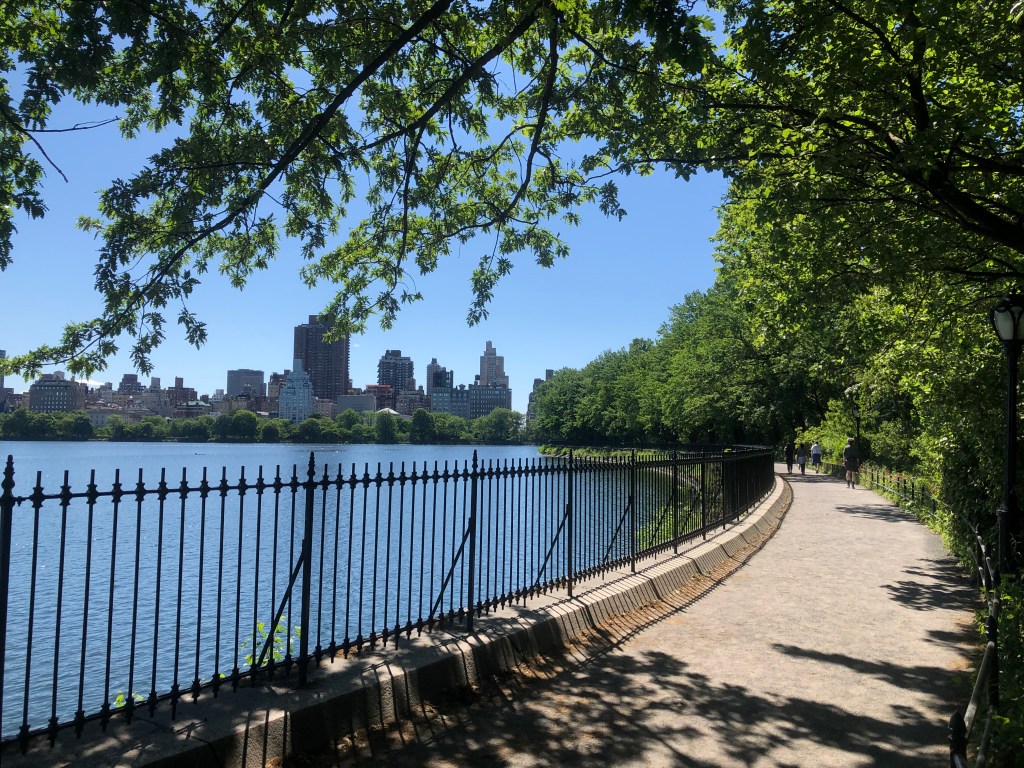
Entrance to the reservoir trail, with view of the Upper East Side.

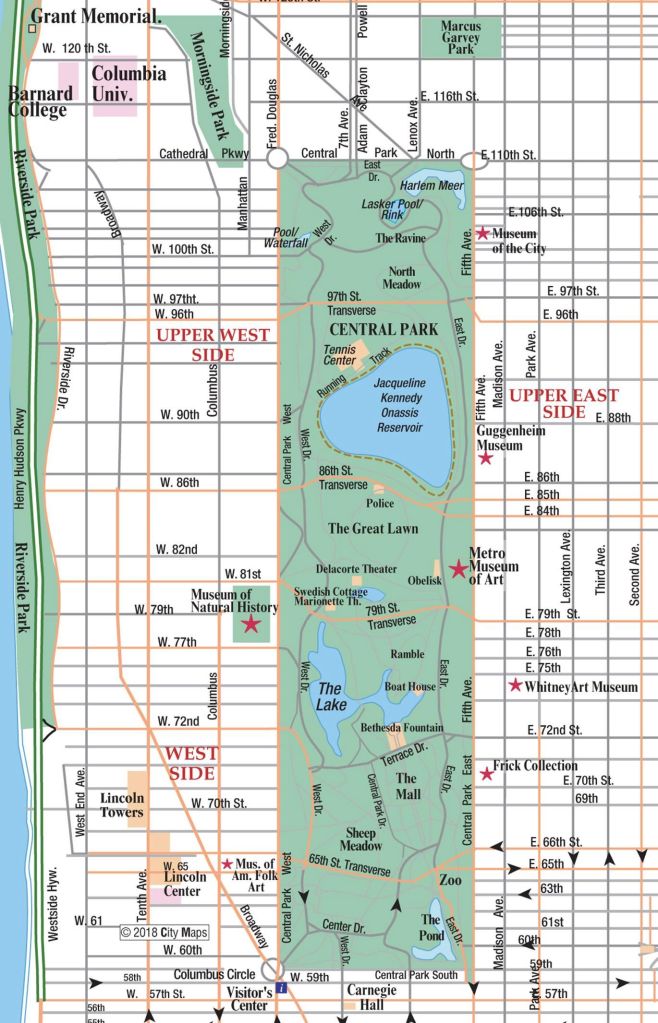
Recently, as I started running in Central Park, the sense of disorientation has become stronger than ever. I would usually start my run at the 77th street entrance on the west side of the park and follow the path to the Reservoir located on 86th, where I would then continue around the reservoir counterclockwise. Almost immediately upon entering the park, I would be plunged into the canopy of trees thick with leaves, which would soon start to block the buildings, eliminating any difference between the park and some nameless trial in the Bear Mountains. Before long, however, I would reach the entrance of the reservoir trail. The view is stunning: a row of pre-war buildings juxtaposed along the Fifth Avenue would manifest themselves first, their white or light yellow facades glimmering under the afternoon sun–how stunning the view must be looking out of their windows at the park! By then, I would have barely begun to exhaust my stamina and thus still capable of enjoying the view and breeze as I run. It is also at this point that I would experience the sense of disorientation for the first time, as the buildings are laid before my eyes in a peculiar angle utterly different than that formed as one wanders within the city’s streets. Before long, my joints would start to burn with my breath becoming heavier. These symptoms would usually amount to the decision to take a short break at the first brownstone building I see along the trail, which I have remembered well since my first visit to Central Park six years ago (the building, which herald the approach of the stunning view of the reservoir, would, whenever I enter the park from the east side, make my heart beat like that of a traveller who glimpses on some low-lying ground a stranded boat, and cries out, although he has not yet caught sight of it, “The Sea!”). It looks rather like a military outpost, albeit windowless, with ‘1884’ carved above its frieze (I never stopped wondering what the date means, perhaps the time it was constructed?). Although I’ve never seen anyone entering or exiting the building (after all, where are the doors?), its existence is by no means meaningless, at least to the runners, since the two of them along the reservoir trial can be conveniently used as markers for the progress of one’s run and on top of that, as in my case, water supply stations.

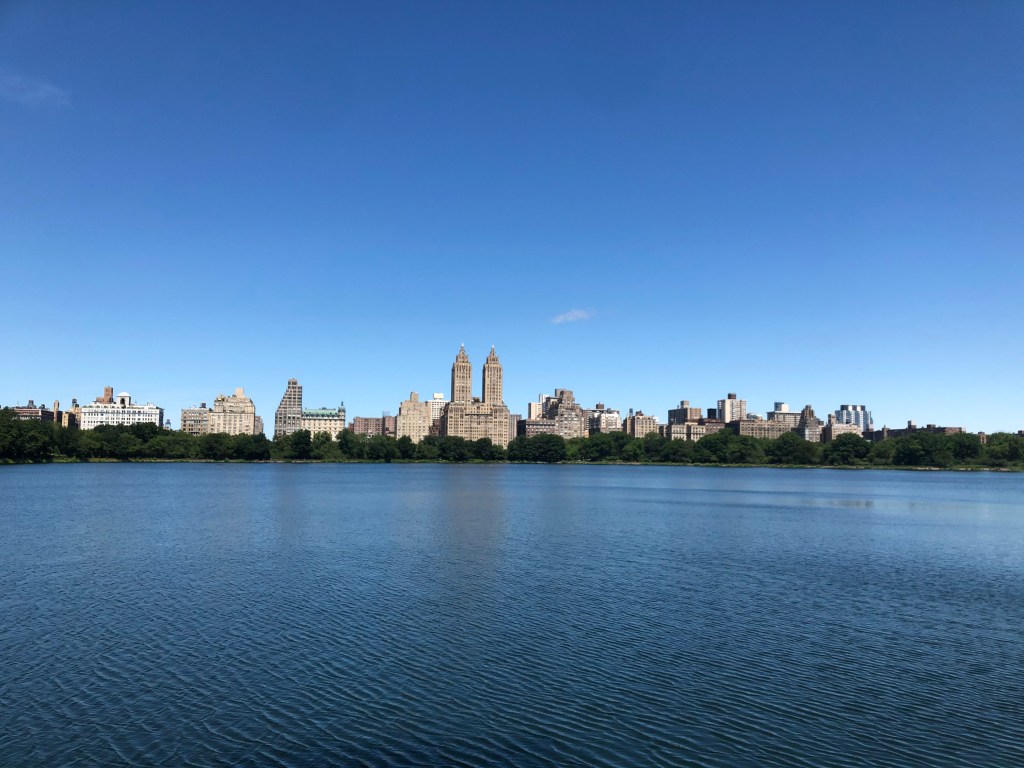
View of the Upper West Side with El Dorado (twin towers) in the middle.

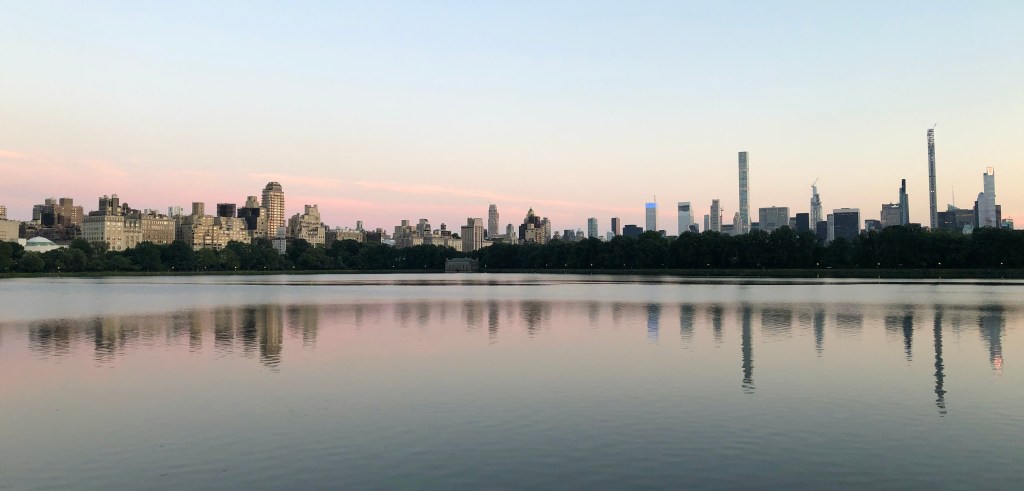
Passing the ‘outpost’, I would enter a straight path stretching northward for about ten blocks. The sense of orientation that has been disrupted by the winding trail immediately returns, and the view regains its order as its relative position in space with regard to the streets and avenues of Manhattan become once again imaginable. The buildings on the Upper West Side would stretch indefinitely into both directions, almost mirroring those on the East Side a few moments ago. The sense of order, however, is inevitably accompanied by a sense of boredom, which, even the occasional glimpse of the beautiful twin towers of ‘El Dorado’ is incapable of fully taming. Finally, the turn of the trail would become visible, leading to a second ‘outpost’ looming behind the trees, and I would once again be able to locate myself within my run. Feeling increasingly exhausted, I would aim the second ‘outpost’ as my temporary destination, before which, I would first reach the north side of the reservoir, where the view is more unobscured than ever. The ‘millionaire row’ of the 58th street would manifest itself before me, with the iconic 432 Park Avenue, Steinway and Central Park towers penetrating into the clouds, leaving an almost equally sharp reflection onto the water, like the cloud-piercing blocks I stubbornly stacked to build in Minecraft. In the meantime, the buildings of the Upper East Side and Central Park South, apparently connected by the trees below them, would merge into one row of buildings to fill up one’s horizon, as if they are not in fact separated by a 90-degree angle, with their joint identifiable only by the sudden transition in architectural style. Without a clear sense of where the streets and avenues are, I would once again lose my sense of orientation, often to a greater degree than the first time.

View of the Upper East Side and Central Park South (The tallest buildings are, from left to right, 432 Park Avenue and Steinway Tower (under construction), respectively).
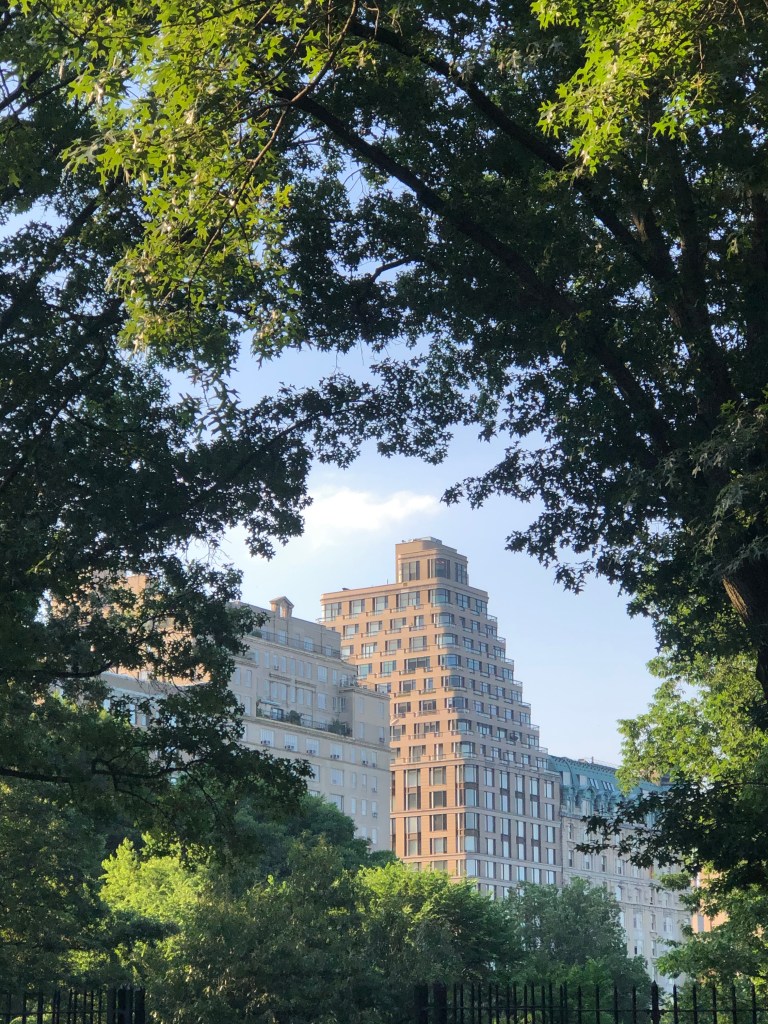
Peek of an Upper West Side building through the trees.

This uncanny feeling would continue through the rest of my journey, along the remaining contour of the reservoir, and would indeed be exacerbated as I peek through the trees at the buildings’ facades, expecting them to be perfectly parallel to the direction I am heading but finding it pointing altogether to another.

These feelings of disorientation reminds me of Merleau-Ponty’s phenomenology of perception, which points out that as we perceive objects, we are not just viewing it from our everyday perspective, as dictated by our eyes, our distancing to the object, etc., but we are also, in the back of our mind, engaged in an infinite number of vague perceptions from the angles from which the object might be observed and approached. To me, New York City, or more precisely, the map of Manhattan is such a frame of reference. Having lived in the city for a certain period of time, one gets accustomed to locating things in terms of their “coordinates” on the “chessboard”–for example, when I tell my friend to meet at ‘that McDonald’s on West 4th and 6th Ave’. As a result, one unconsciously modifies their mental map to accommodate the city’s layout and gradually form the expectation that only two possible setups are possible for the buildings relative to the direction one’s heading–either completely parallel, or completely perpendicular. These implicit assumptions and expectations are robust to most “unorthodox” neighborhoods of Manhattan, as the order of the chessboard remains salient as long as the ‘regular’ buildings remain visible. However, these expectations are completely overthrown as one enters Central Park, where no trace of these regularities can be found. Hence the sense of disorientation.

Map of Central Park and it’s surroundings.

Bookstores

I did not form the habit of reading until after I started to work. Having just committed my first serious job-related mistake and dreaded by the subsequent criticism and self-doubt, I decided to embrace reading as a distraction. I picked from the shelf Crime and Punishment by Fyodor Dostoevsky–a book I purchased in my freshman year of college but had remained buried ever since. It was August 12, 2018, and my reading journey started in the Bluestone Lane Coffee in West Village.

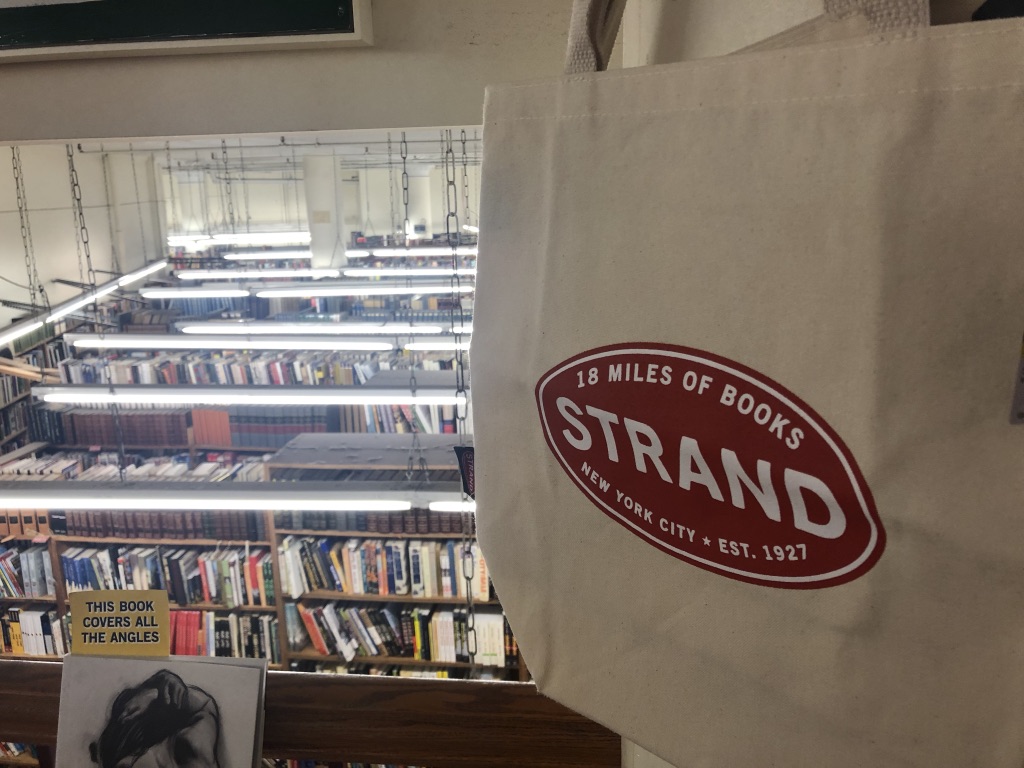
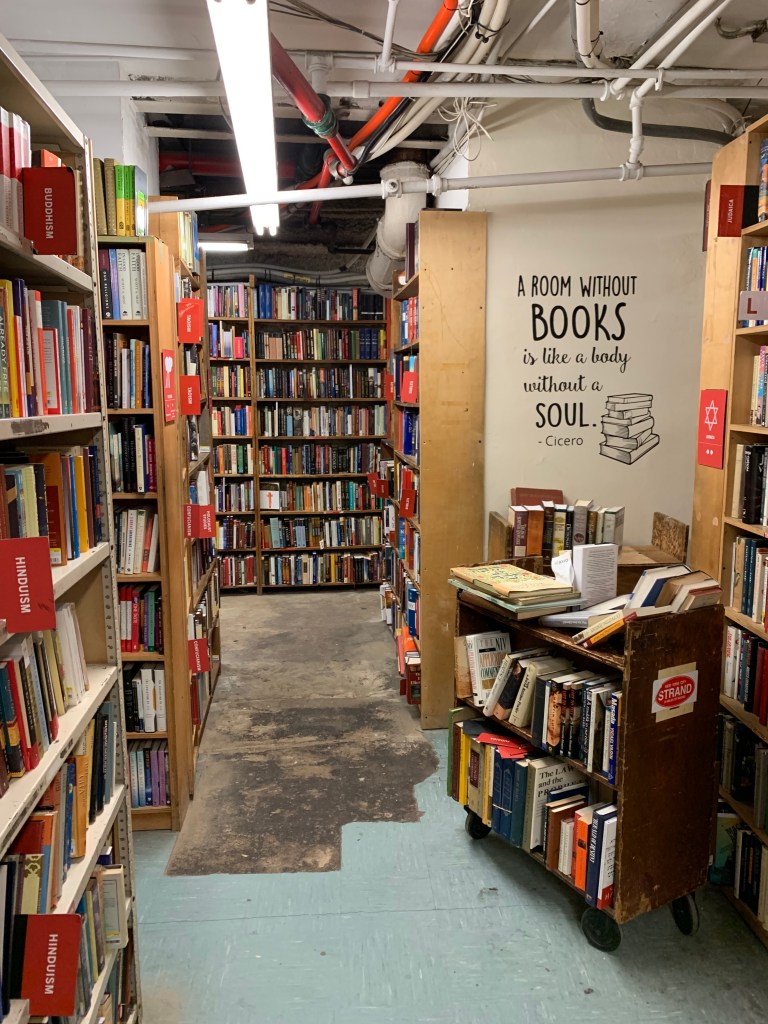
Strand Bookstore, taken from the stairway to the second floor.

The novel–the very first that I committed myself to since Dickens in high school–took me two month to finish. Eager to find my next target, I dropped by the Strand Bookstore on my way home one night and luckily found The Waves by Virginia Woolf, which I had since considered one of my favorite novels. What’s more, I discovered the secret pleasure of visiting bookstores, especially during the idle hours of 7-9pm on a weekend night, after the closure of the coffee shop in which I studied throughout the day–a habit that would last through the following two years as I lived in the city.

The entrance of the Strand saw a round desk, upon which laid the somewhat intimidating “classics”–from Tolstoy to Joyce, Woolf, and Steinbeck. On my first visit, I decided to look instead for more “relaxing” readings and ended up picking What we talk about when we talk about love by Raymond Carver–digging out from the discount section of the first floor the same Vintage print as the Cathedral I read in high school, with a Strand-style yellow “out of print” tag attached to its back. It was an easy-read. The stories were sufficiently short–or minimalistic–that I could often finish them on my subway ride to work, or during the lunch break. Nevertheless, its depiction of the life of suburban middle-aged middle-class Americans did little to transform my view on love–anyhow, to a much lesser extent than The Revolution of the Heart.

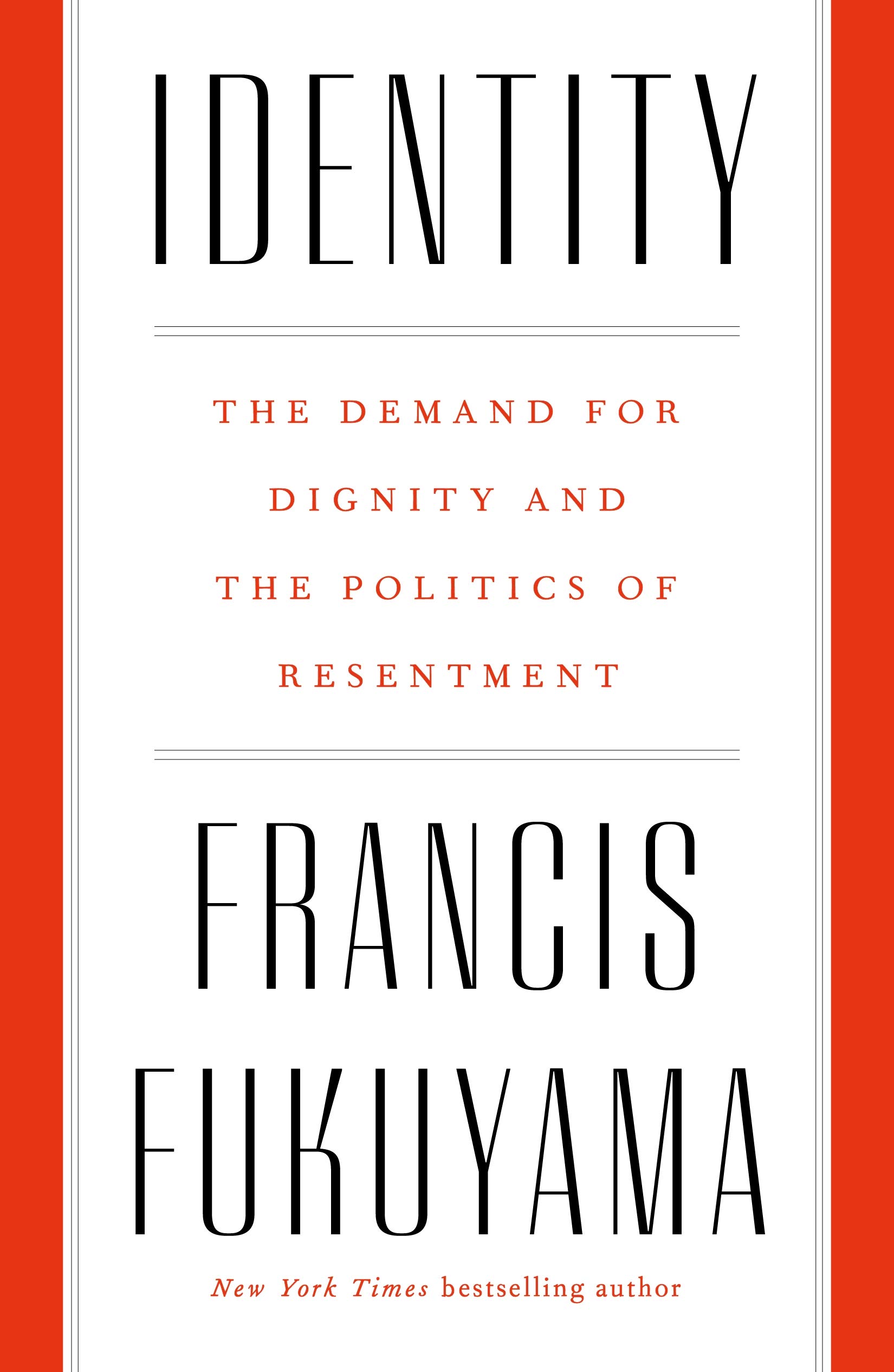
I was driven to visit Strand largely by a vague expectation for serendipity. On a November night, perhaps searching for a psychology textbook, or out of mere curiosity, I for the first time stepped down to the basement of Strand. It was at first blush a considerably less desirable environment than the ground floor–there was no AC, only a few huge noisy fans blowing from the corner of the stacks wind no cooler than the room temperature, which made me wonder whether philosophy and psychology, subjects as important as these, deserved a better treatment by the bookstore. Roaming between the philosophy stacks, my glance was caught by Upheavals of Thought by Martha Nussbaum. Perhaps impressed by its quotation of Proust on the title page, or the apparently huge discount (from $100 to $25, which I soon realized was a brag since the book was available at $20 on Amazon as well), I unprecedentedly purchased this multi-volume book of over 700 pages. On the same day, I also purchased the newly released Identity by Francis Fukuyama, having discovered that it was almost 50% off. I did not know Nussbaum at that time, neither had I learned much about Fukuyama, besides my friend’s recommendations on a few occasions. However, this lack of knowledge and plan was precisely what, by definition, constituted serendipity; the former became my favorite book of all time, with Nussbaum my favorite contemporary philosopher, and the latter had encouraged me to participate in an extremely inspiring and, indeed, still-continuing, conversation on Chinese-American identity with Hui, a close friend of mine.

The corner of Strand’s lower level, where the Psychology and Philosophy sections are to be found.

Lingering among the stacks, I often had a mixed feeling–one of pride and humility. I was proud that I seemed to have become what I had always aspired to be–someone who likes to read–despite the fact that by going to the bookstore I was barely “preparing” to read. Each stack seemed to contain hundreds of possible worlds I could delve into and come out of as a better person of some kind. Meanwhile, however, I was reminded, like Socrates, or Jon Snow, of my own ignorance. I was bothered by the realization that a life-long devotion to reading wouldn’t exhaust even one percent of the stacks I was waking under, and how much beauty I must inevitably miss along this journey. No better for the authors–insightful as their ideas might be, most of them would not be communicable beyond the small circle consisting of their family, the publishers, and a few close readers.

The Book Culture on the Upper West Side, another bookstore I have deeply enjoyed over the years, however, used to arouse an entirely different set of feelings. While visiting the Strand often involves a practical mindset, from which I would hold the expectation that I would come out of it with at least some updates on my reading wish list, if not copies of new books, I would visit Book Culture on Columbus in search of pleasures of a very different kind, almost aesthetic. The store, located on 81st and Columbus, unlike its Columbia branch, was surprisingly small, owing less to its limited interior space than how that space was utilized. There was only one stack of fictions (which, unlike the fiction sections of Strand, consisted of authors most of whom I had never heard of), adjacent to a stack of photo albums and architecture portfolios, whose presence seemed to me to serve decoration purposes only. And although the store came with a lower level, it was curiously ‘wasted’ on children books and a kids’ playground (which I was also forbidden to enter as an adult with no kids). Almost equally luxurious was a space at the entrance of the store, which, instead of holding bookshelves, accommodated items that appeared rather uncanny for bookstores–from incense candles to flower pots. This peculiar setup, however, made me want to visit the store all the more. On weekday evenings, on my way home, I would often find myself taking a slight detour off the 79th street station to indulge in the warm glowing light and the mesmerizing incense of the Book Culture on Columbus.

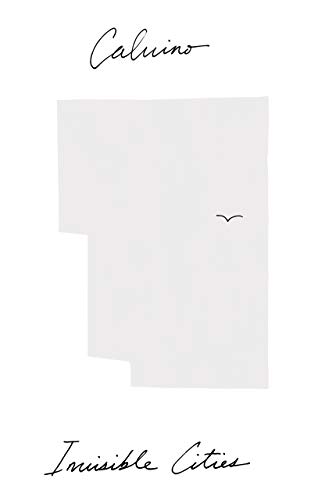
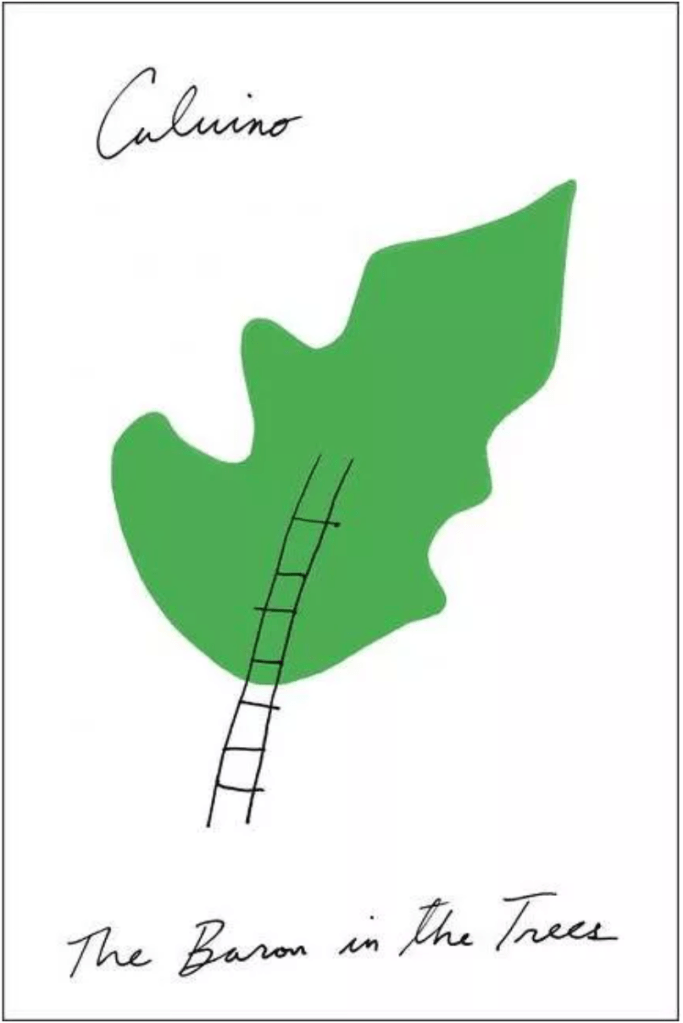
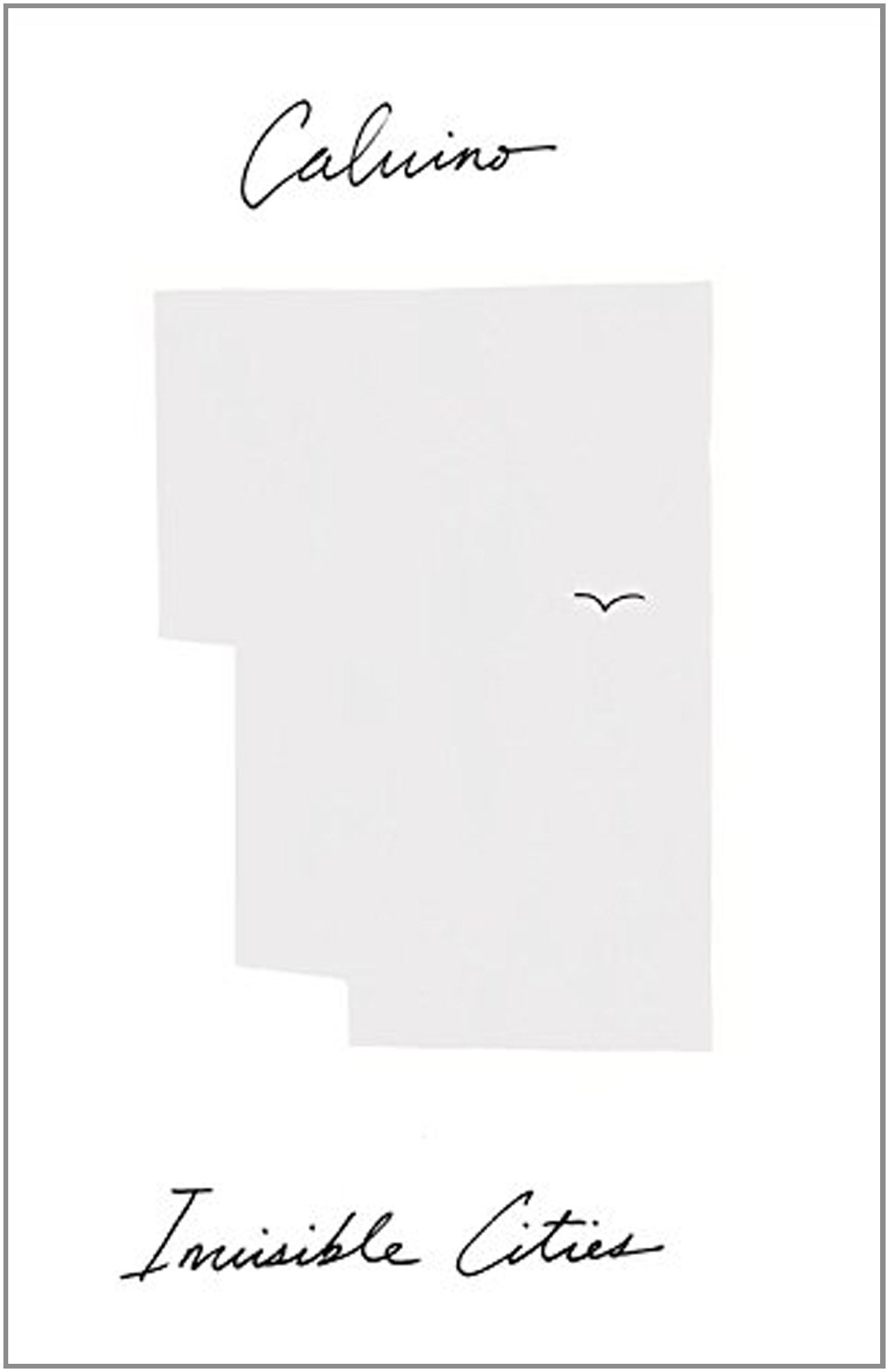
Now looking back, there seems to be a connection between the vibe of the bookstore and the kind of books I would purchase there. After failing to receive my order from Amazon, I purchased at the Book Culture on Columbus the first two volumes of In Search of Lost Time by Marcel Proust, translated by C. K. Scott Moncrieff. Upon seeing the white sheet and pillowcase on the cover the first volume, I was immediately brought back to the night at Combray when Marcel finds himself unable to fall asleep; and a glance upon the second volume, which came with Monet’s Hotel des Roches Noires in Trouville, would always invoke in me some vague memory from my visit to the Musée d’Orsay. The fiction section also contained a full collection of Italo Calvino, whose cover never failed to impress me–whether it was the lonely bird hovering above the Invisible Cities, or the lively shade of green surrounding The Baron in the Trees–the minimalism of which appeared in perfect synch with the bookstore’s interior design.

On a December day in 2019, I learned from a friend that the Book Culture on Columbus had permanently closed due to the raising rent. Shocked and sad, I looked for photos of the bookstore on my phone, hoping to recover some memories about the place, but realized that, as much as I enjoyed the bookstore, I had not taken a single photo of it. Since then, I had paid few visits to the neighborhood, and, even on days when I decided to get some drinks from the Starbucks next-door, I would find my gaze shunning the abandoned bookstore, lest I should catch glimpse of its decrepitude. Soon came the coronavirus, which forced Strand to close as well, leaving me with the fear that I might not be able to visit either bookstore by the time I leave NYC.

Time passes, and I was once again at the Starbucks earlier today. Unable to find an outdoor seat, I kept walking up Columbus Ave. and, as I passed where the Book Culture used to be, caught glimpse of something that caressed the strings of my mind–books! I stopped to examine the facade of the store more closely. First entering my visual field was a white-painted ‘The Strand’ against the scarlet frieze, which immediately elicited a vague excitement that in a few seconds would turn into an elucidated bliss as I saw the iconic red signs of the familiar bookstore, looming behind the glass window along with a dim reflection of the city streets, which suggested the veracity of the hypothesis that had been source of my excitement–the Book Culture has reopened as a new branch of the Strand!

Biking in New York City

The COVID-19 has substantially transformed my mode of living. Having stayed home for more than a month, I find myself dwelling more and more upon my memories traversing the city, particularly via bike. As I foresee the epidemic to continue throughout the summer, and my imminent moving to graduate school somewhere else, I am occasionally dreaded by the thought that I may not be able to resume my biking routines, along with many other activities, before leaving NYC. So I’d like to write these memories down–to start with biking–so as to record the feelings that I may no longer be able to experience in vivo, and to create a repertoire of moments in the city that I will continually revisit and try to relive.


Riverside Drive and Park

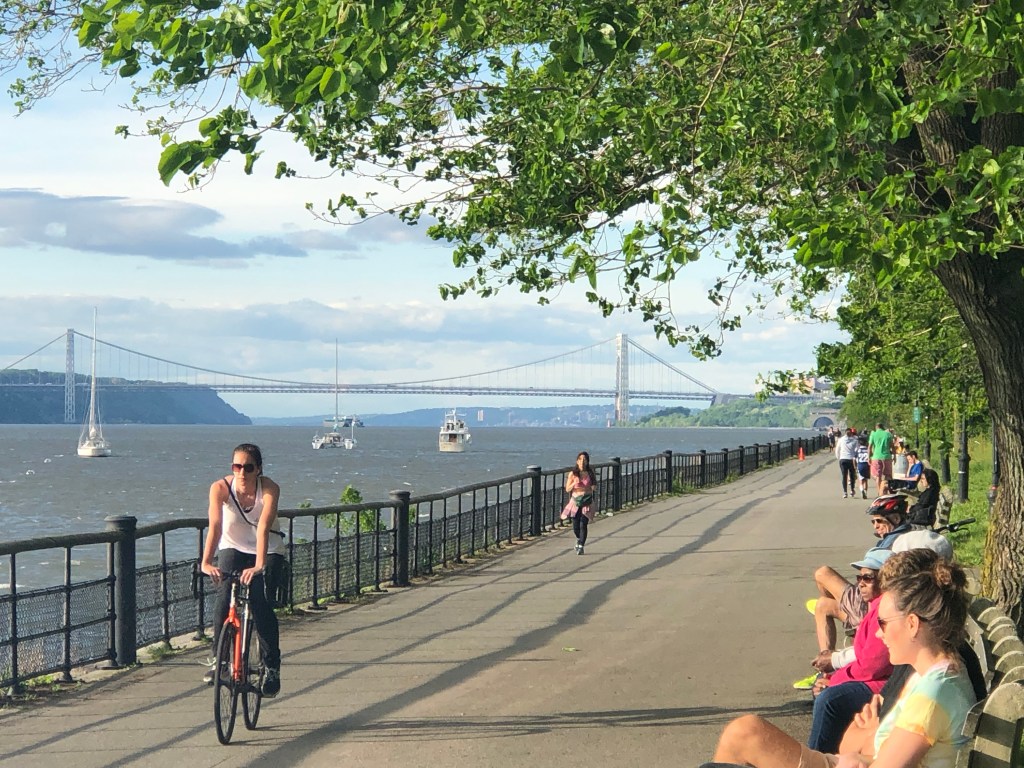
Riverside bike lane near 96th Street

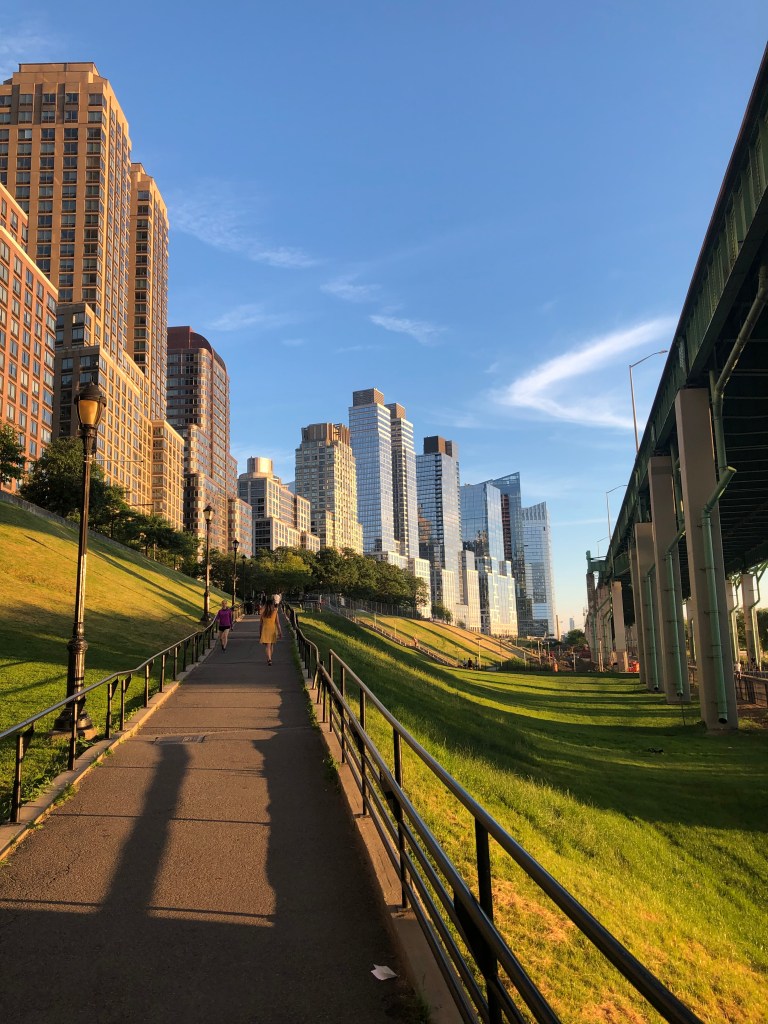
It was late-summer of 2018 when I first discovered the path to Riverside Park from the Riverside Drive. Having descended from Broadway, I was immersed by the canopy of trees along the sidewalk, which protected me from the still-burning sun of 5:30pm. As I reached 96th street, intimidated by the roads uphill (which my Citibike was clearly not designed to overcome), I would turn right into the road shared by cyclers and pedestrians, overseeing the river. The view of the river was projected behind the veil of trees and sometimes I would park my bike and stare at the shades of the cloud from the chinks of the leaves. Soon I discovered a secret path leading directly to the bike lane right beside the river. A whole new part of the world was disclosed to me–the glimmering river, the unobstructed wind bringing with it a slight odor of the sea, and the pedestrians and runners that I had to pay close attention to lest I should run into them. Occasionally there would be old people sitting on the bench with their guitars, or couples picnicking on the meadow behind the benches. Upon its discovery, this route immediately became my favorite and I would bike through it whenever possible, sometimes all the way from 125th street, and sometimes all the way to 16th street, where I could indulge in the variety of dinner choices of Chelsea and West Village.

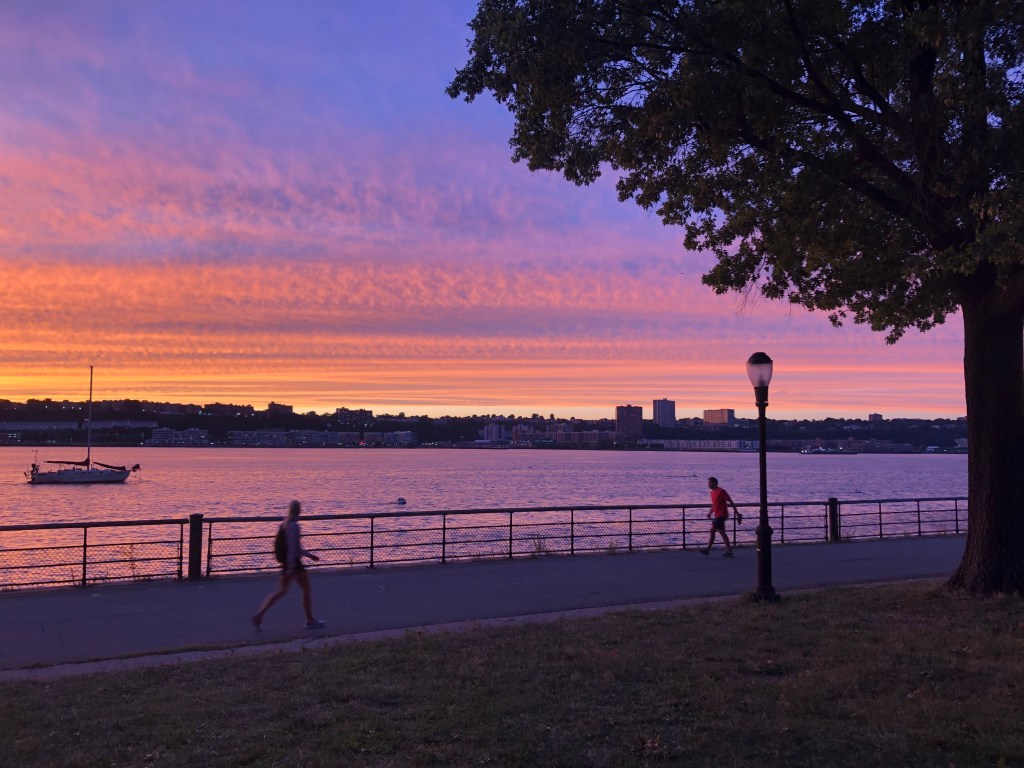
Riverside Park at sunset

Time passed, and the view of the river changed dramatically in the fall. In mid-autumn, the time I got off from work would often coincide with the sunset. I would rush out of the campus to the bike kiosk if I saw a trace of the glowing sunset projected onto the clouds. As I reached the riverside bike lane, I would park beside a bench and watch the clouds as they transformed from white to pink, to red as if they were burning, and finally to dark blue as they became merged with the rest of the sky at nightfall. Before long, however I would be harassed by the intruding thought that my bike had to be returned every forty-five minutes and the closest bike kiosk was all the way on 70th, meaning I had to rush before time was up. The rest of my trip was neither distressing nor repetitive, though, since the landscape changed once more as I reached the hill at 79th street.

View from the hilll

At 79th street was a hill that oversaw the pier and the bike lane. That platform on top of the hill cost considerable amount of effort to reach, but it was worthwhile. Not only was the view beautiful, but the bikers could enjoy a brief moment of excitement by rushing downhill and reaching perhaps the fastest speed possible along the entire riverside park (a speed perhaps rivaled only by the downhill ride from 116th to 125th on Amsterdam, which was much more dangerous because of the traffic and the police).

End of my biking route at Riverside Park

Then I reach the usual end of my biking route along the river (assuming my destination was home). It looked more park-like than anywhere else on the way, as bike lanes were completely replaced by pedestrian walks (of course I had to dismount), and I would always find kids throwing football with their parents, older people walking their dogs, and younger ones exercising. Whether I would be able to park my bike was completely a matter of luck, since it was the only Citibike kiosk within the five blocks of the Riverside Drive neighborhood. When I couldn’t park, I would find keep riding to Lincoln center and perhaps have a quick dinner at Dig Inn, or sit in the Starbucks on 66th if it was not yet dinner time. When I found a kiosk, however, I would walk back to the riverside and let the glass curtain walls of the luxury buildings inform me of the city’s modernity, updating my prior impression of archaicness, which had been formed as I occasionally caught a glimpse of the facade of the prewar buildings through the trees on my way, which I unconsciously used to mark the progress of my trip.


My 2019 Booklist

2019 was the first whole year throughout which I have been systematically reading. Having set the somewhat optimistic goal (given I’m a slow reader) of reading 25 books at the beginning of the year, I finished 19 of them, the shortest of which took a week and the longest over four months. I wanted to share with you the five of them, ordered by time, that I drew most inspirations from and had most to say about.


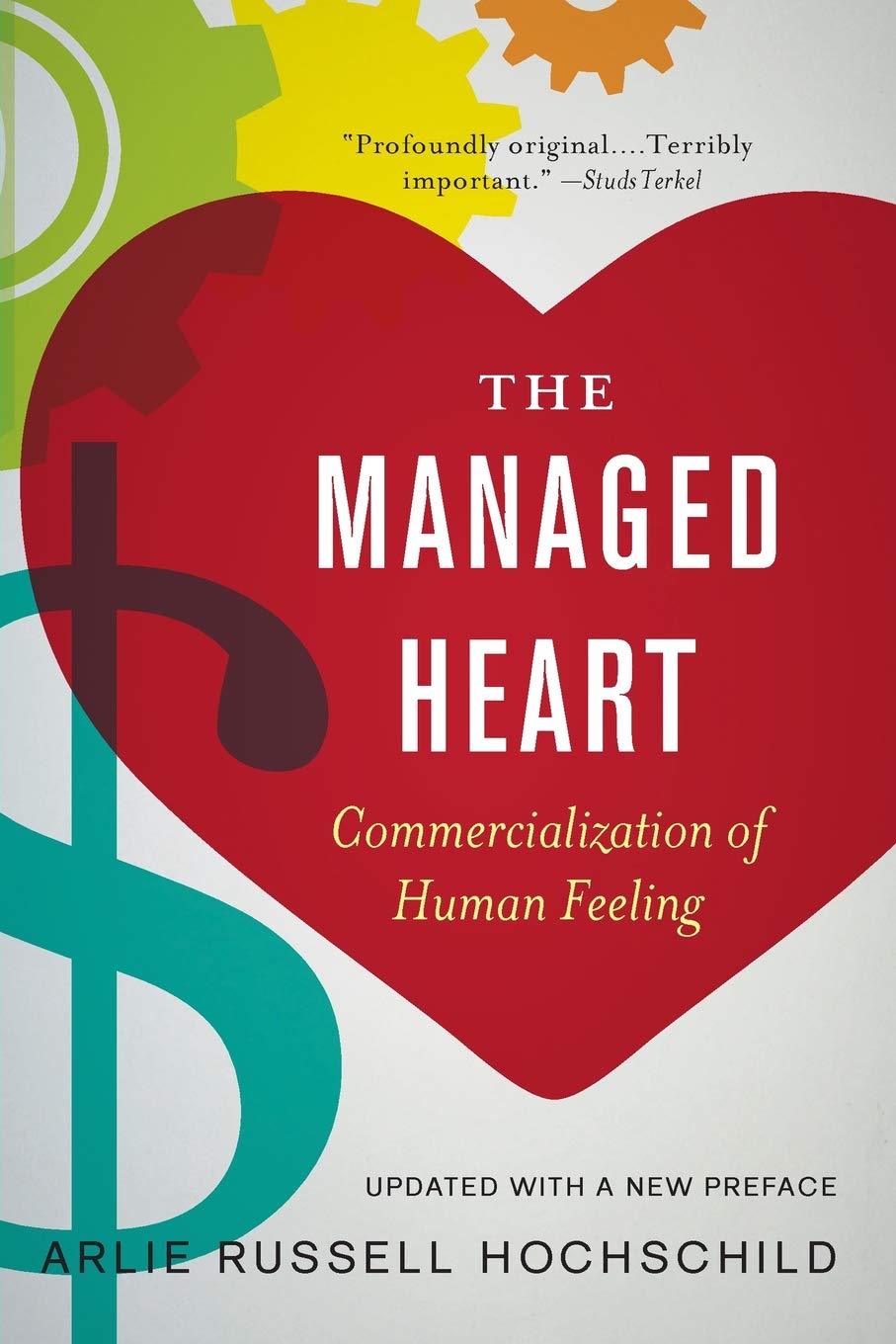
[Sociology] The Managed Heart: Commercialization of Human Feeling by Arlie Russell Hochschild

I learned about this book in an academic context. In Spring 2018, I was doing literature search on emotion and emotion regulation and saw Hochschild’s name in a citation to the idea that we regulate emotions to conform to social norms, which I immediately identified with, given my long-standing interest in the concept of the “right way to feel”. In The Managed Heart, Hochschild explored the concept of “emotion labor”, the idea that those in the service industry, especially females, are engaged in not only physical work, but emotional efforts as well, but this latter part has been largely ignored, both in terms of the compensation structure and the psychological burden it induces. Hochschild explored emotion labor through two case studies, featuring flight attendants and debt collectors, respectively. Whereas the former are trained to up-regulate positive affect and down-regulate negative ones in their service, the latter do the opposite, up-regulating the expression of anger to inflate their status in relation to the debtor. To explicate the sources and consequences of these emotion regulation processes, Hochschild cites the distinction drawn by Lionel Trilling between sincerity and authenticity. In short, sincerity prescribes how one should express their feelings, namely, to express them as they are; authenticity, however, requires that one feels the emotions that should be felt, emotions that are consistent with who one truly is. When the need for authenticity clashes with the feeling rules of the workplace, individuals, sensing a need to bridge their gap, are taxed with cognitive dissonance. As a result, individual workers are faced with a choice between assimilating their feelings, hence their identities, to their company’s standards, versus maintaining their selves at workplace through surface acting. The trouble is that the former leads to a burnout, and the latter a lack of motivation for work.

Hochschild’s take on the commercialization of feelings is arguably feminist, as she devotes two thirds of her case study to flight attendants, who at the time of her writing were almost exclusively female and attributed the problem of emotion labor in part to the asymmetric feeling rules our society held for male versus female (e.g. in the appropriateness of anger). Hochschild’s feminist approach, however, does not qualify her argument’s relevance to the broader audience beyond American airlines or the service industry more generally. Emotion labor has its philosophical roots. Insofar as one believes in the value of authenticity–for example, that ideally one should love what they do and do it not merely for the material compensations–how to feel at work is at stake for them, and expectations about the appropriate ways to feel remains a risk factor of psychological importance.


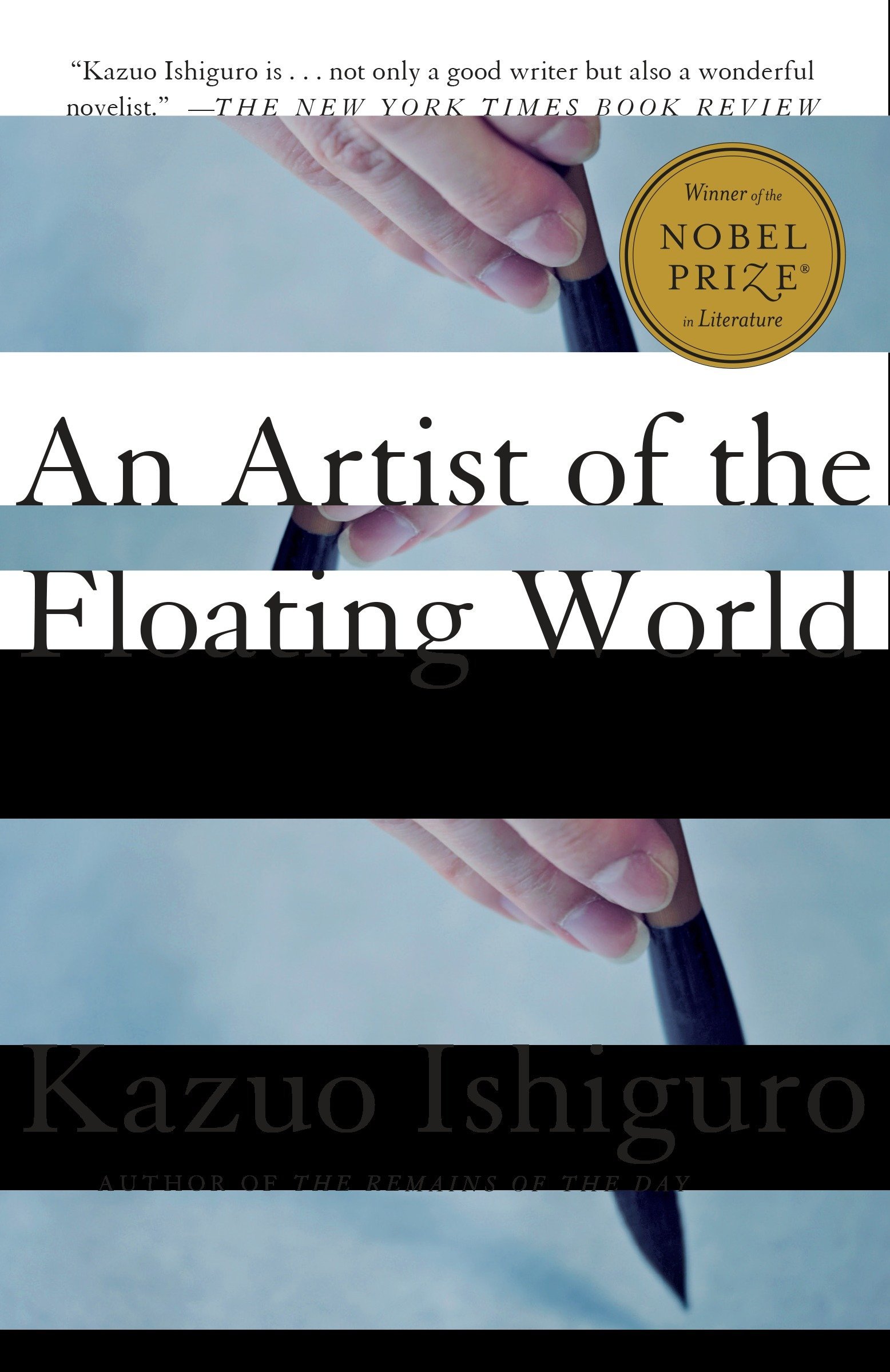
[Fiction] A Pale View of Hills and An Artist of the Floating World by Kazuo Ishiguro

The title implies the theme of the book—memory. Ishiguro is surprisingly insightful about the motivated nature of memory, that it is subject to (unconscious) distortions in line with one’s goals and concerns. Throughout the novel, Sachiko is intentionally portrayed as a bad mother—frequently ignoring her daughter’s needs and autonomy, yet claiming that she cares most about her. Meanwhile, the narrator (Etsuko) seems strangely tolerant of such attitudes. While she kept raising doubts about Sachiko’s intentions, she always ended up justifying them. This incongruence culminates at the end of the novel, as the reader realizes that Etsuko and Sachiko are the same person. This identity strikes me mostly because it reveals to me the malleable nature of memory. By individuating her old self—whose decision to emigrate to the UK indirectly led to her daughter’s depression and later suicide—Etsuko was able to temporarily step back from her guilt and reflect upon her past from a neutral point of view. Such an effort, however, ultimately failed as Sachiko’s memory gradually merged with her own.

Ishiguro further explores the relation between memory and implicit guilt in his second novel, An Artist of the Floating World. Ono, the protagonist, attributed the failure of his previous marriage negotiation for her daughter to the stigmas of his past—that as an artist, he contributed to Japan’s imperialist propaganda during the Second World War. Ishiguro, however, never made explicit whether it was the true reason behind the failure of the marriage negotiation. Instead, the confusion Ono’s wife and son expressed towards his confession during the current year’s negotiation suggests that the hostility Ono perceives might after all be his confabulation. What is truly hostile to Ono is his own conscience. 

Aside from the psychological nature of the novel, An Artist also brings up interesting questions concerning the relationship between art and morality. For example, is Ono right in believing that an artist should in his work engage in sociopolitical causes, instead of pursuing pure beauty? More generally, to what extent can and should art play a public (and potentially political) role? A second line of questions concern the aesthetic and moral values of art—does the fact that an artwork is created through immoral means or that it prescribes morally questionable reactions qualify its aesthetic value (as Berys Gaut’s ethicism would argue)?


[Literary Criticism] Revolution of the Heart–A Genealogy of Love in China by Haiyan Lee

Revolution of the Heart is my favorite book of the year, and probably my favorite of all time, despite its esoteric language and occasional indulgence in quotation that makes it even harder to read. The book is a deconstruction of the concept of love, or qing (情) in Chinese literature from the 18th century to the late 1950s. The deconstruction of qing is characterized by three stages–or structures of feeling–the Confucian, the Enlightenment, and the Revolutionary. Under the Confucian structure of feeling, love and emotions more generally are regarded as legitimate only insofar as they are consistent with the Confucian morality of social relations. Under the Enlightenment structure of feeling, however, emotions become significant in their own right. Their legitimacy lies solely in their authenticity, and to live authentically is to pursue of one’s love despite pressures from one’s family and the norms of the society. Finally, the revolutionary structure of feeling is characterized by the integration of romantic love with patriotism and one’s commitment to class struggles. Qing‘s legitimacy once again relies upon external sources–in this case, one’s duty to their country and commitment to their social class. Romantic love merges into camaraderie love .

Having been reading and conducting research on emotion, the book brings to me an entirely distinct approach than that which scientists take to study emotions. Affective scientists, as their title (‘affect‘) suggests, focus on the physiological responses or appraisals that take place at the individual level, over the course of seconds, or perhaps minutes. Yet, I often found this approach somewhat insufficient in capturing how we actually think about emotions. Unlike psychologists, we tend to use the word to refer to experiences that last for weeks, years, or even decades (consider the love between a couple), which may also be shared at the collective level (e.g. nationalism), and which, importantly, map onto the things we care most deeply about–namely, what’s valuable to us and how to live a good life. The Revolution of the Heart, by examining emotions (in particular love) in their historico-sociological contexts, has well captured emotions’ conceptual richness as well as their ethical significance. Moreover, the deconstruction of love helps elucidate an ambiguity inherent in the word, in both English (love) and Chinese (爱, or 情). While the greek distinguishes between three types of love–philia, eros, and agapé, these boundaries between them get murky as these concepts are compressed into the single term love. Haiyan Lee, by showing how each aspect of love was construed and represented in literature throughout China’s contemporary history, has helped us appreciate the complexity of the term and emotion’s fascinating entanglement with psychology, philosophy, and society.


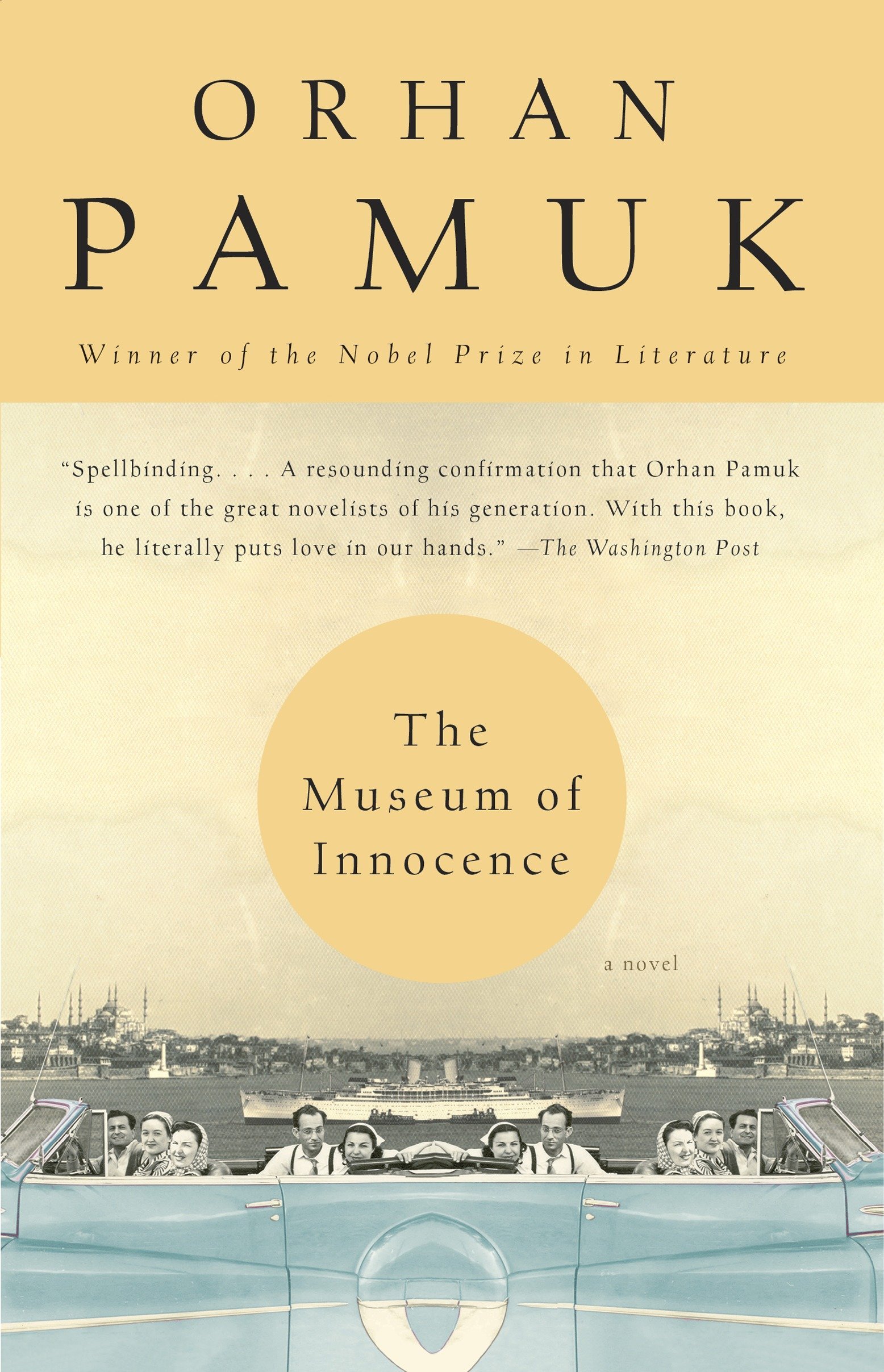
[Fiction] The Museum of Innocence by Orhan Pamuk

ΩA confusion dwelled in me as I read The Museum of Innocence: how exactly did Kemal fall in love with Fusun? The way they became entangled seemed at first glance no more than a hook-up (the uncanny nature of which in Turkey in the 1970s, of course, might have added to its romantic appeal). And given the passions that drive hook-ups are often short-lived, I was confused as to why Kemal’s love for Fusun would haunt him for eight years and ultimately transform into his obsession with collection. Essentially, what confused me is how can love of such depth and intensity arise from “mere” sex. While I don’t believe that love has nothing to do with sex, I doubt sex alone is ever sufficient. Love as an emotion, has an intentional structure that is beyond the scope of the bodily arousals that constitute sex. Moreover, how should I make sense of the speed at which love developed between Kemal and Fusun? After all, it took no more than a week or two for them to fall desperately in love, a transformation which, according to the author, was facilitated merely by incessant love-making. 

These thoughts reminded me of Marquez’s Love in the time of Cholera. While reading it, I kept wondering how Florentino and Fermina fell in love through mere correspondence and occasional eye contacts and how that intense but short-lived passion ended up surviving in Florentino for over five decades. In a sense, Museum and Cholera have explored two antithetical forms of love–while love in the latter is glorified by its independence from sexual fantasies, love portrayed by the former arises precisely from sex and seems to consist of both a physical and a transcendental aspect.

Underlying these confusions are narratives that have challenged certain assumptions I held about love. Perhaps one of the assumptions was the following: that love is valuable only insofar as it is transcendental. In other words, love qua physical sensations (e.g. sexual desires) are not worth celebrating unless it reflects values that transcend the immediate need of the self–e.g. the individuality and autonomy implicated in the lovers’ resistance of a repressive social order (cf. The Revolution of the Heart). The Museum of Innocence challenged these assumptions. Pamuk portrayed Kemal in such a way that there is no reason for him to love Fusun, not just in the sense that their relationship was at odds with the societal norms of rationality, but also because Kemal’s fascination with Fusun seemed to be grounded in the mere gratification of sexual desires. Therefore, the book can be seen as Pamuk’s attempt to bring forth a love that deviates from the ideal by portraying a protagonist that is out of the ordinary (whose love ultimately transformed into a fetishism for collection). As I tried to make sense of the Kemal’s feelings and motivations, I was driven to entertain a new concept of love that was utterly different from the canonical narrative of my society. Ultimately, this allowed me to simulate a way of living that is different from my own. In this sense, fictions indeed extends our lives by teaching us to imagine, to empathize, and most importantly, to re-evaluate the beliefs and assumptions we come to hold for granted.


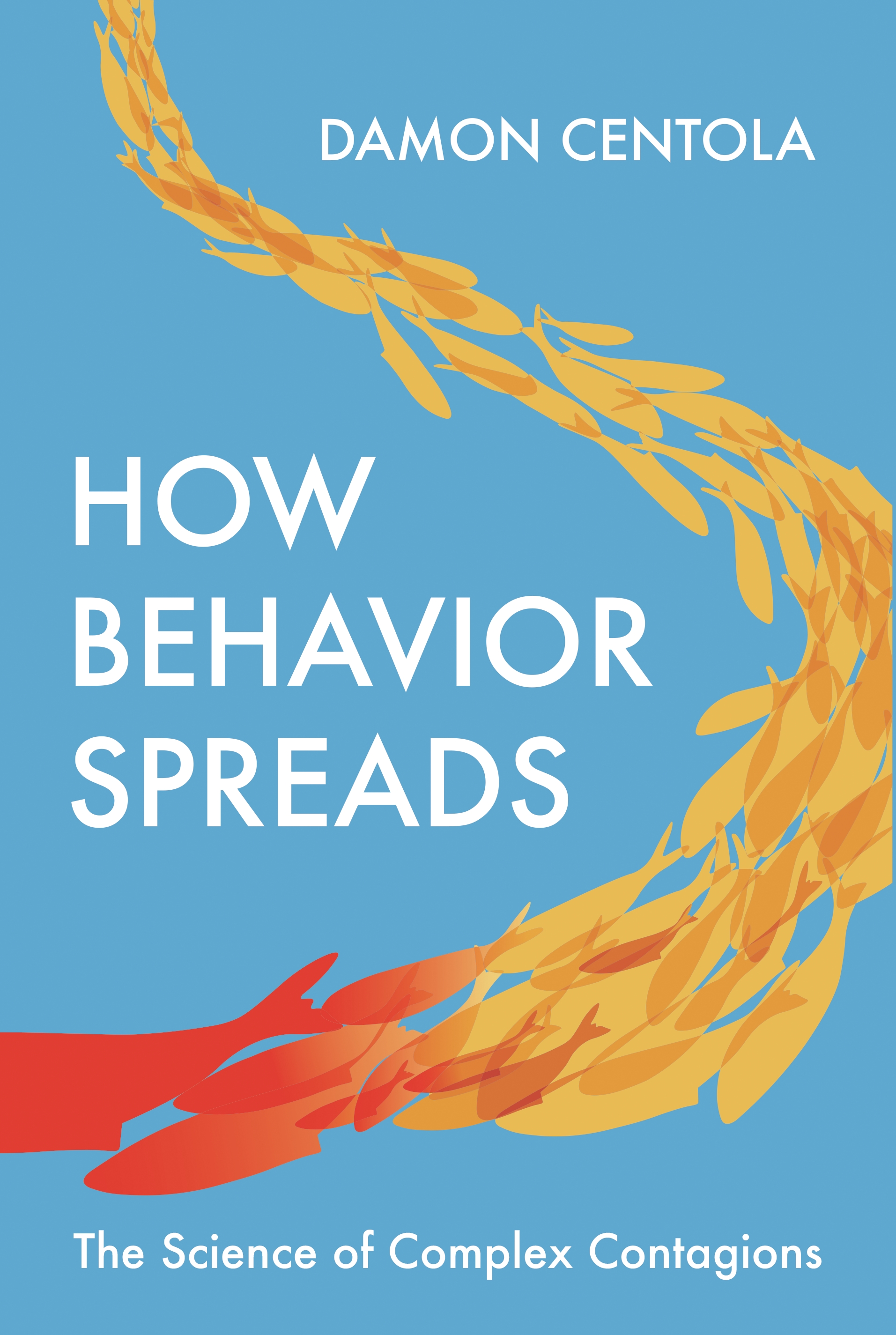
[Sociology] How Behavior Spreads by Damon Centola

A central question How Behavior Spreads examines is: why do innovations and health behaviors often fail to spread as viruses do? Centola argues that the spread of behaviors ultimately depends on two sets of factors: the type of contagion the behavior involves, and the structure of the network in which they propagate. While simple contagion like the transmission of the flu requires single contact to pass from one person to another, innovative behaviors and health information are complex contagions, whose transmission requires reinforcement from multiple agents. While simple contagions propagate fast in small world networks, where the average degree of connection among their members is small, complex contagions spread most effectively in clustered networks, in which most members are connected with their local communities, say family and friends, but not distant strangers. Ultimately, based on these insights, we can begin designing interventions that facilitate the propagation of information and desirable behaviors across various situations, whether to reduce polarization on social media, or to facilitating the coordination among different departments of an organization.

I did not expect, though, that this book’s real-life relevance would be manifested so soon, in the unfortunate outbreak of the 2019 novel coronavirus. Social media platforms like WeChat no doubt have contributed to the propagation of health information and prosocial campaigns in support of people in Wuhan. In a sense, the spread of prosociality, which often takes the form of complex contagion, can be interpreted precisely as a result of the clustered nature of WeChat. At the same time, however, the same mechanisms have allowed misinformation to propagate, in an arguably more vehement manner. After all, research has suggested that we are more likely to heed to and share information that elicits emotions and uncertainty. A challenge we are facing in the coronavirus outbreak, and arguably in the digital age more generally, then, is to facilitate the spread of veridical information and prosocial, rational behavior, while suppressing their inaccurate and irrational counterparts. I believe this could be partly addressed by the government. Insofar as the officials and mainstream media are perceived as trustworthy, their announcement should play a greater role than misinformation in shaping the collective beliefs across the social network.


My full book list for 2019

The Managed Heart by Arlie Russell Hochschild
A Portrait of the Artist as a Young Man by James Joyce
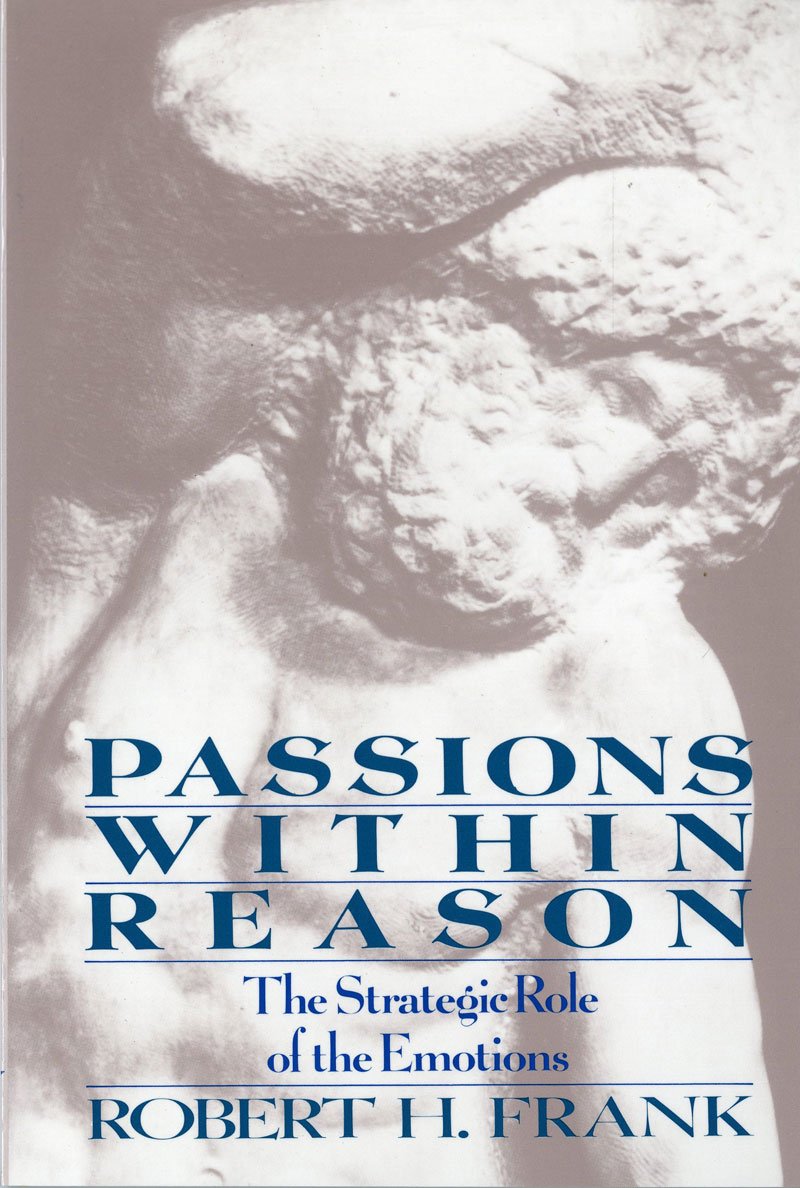
Passions within Reasons by Robert Frank
The Baron in the Trees by Italo Calvino
A Pale View of Hills by Kazuo Ishiguro
An Artist of the Floating World by Kazuo Ishiguro
Stories of Your Life and Others by Ted Chiang
Revolution of the Heart by Haiyan Lee
The Museum of Innocence by Orhan Pamuk
The Unbearable Lightness of Being by Milan Kundera
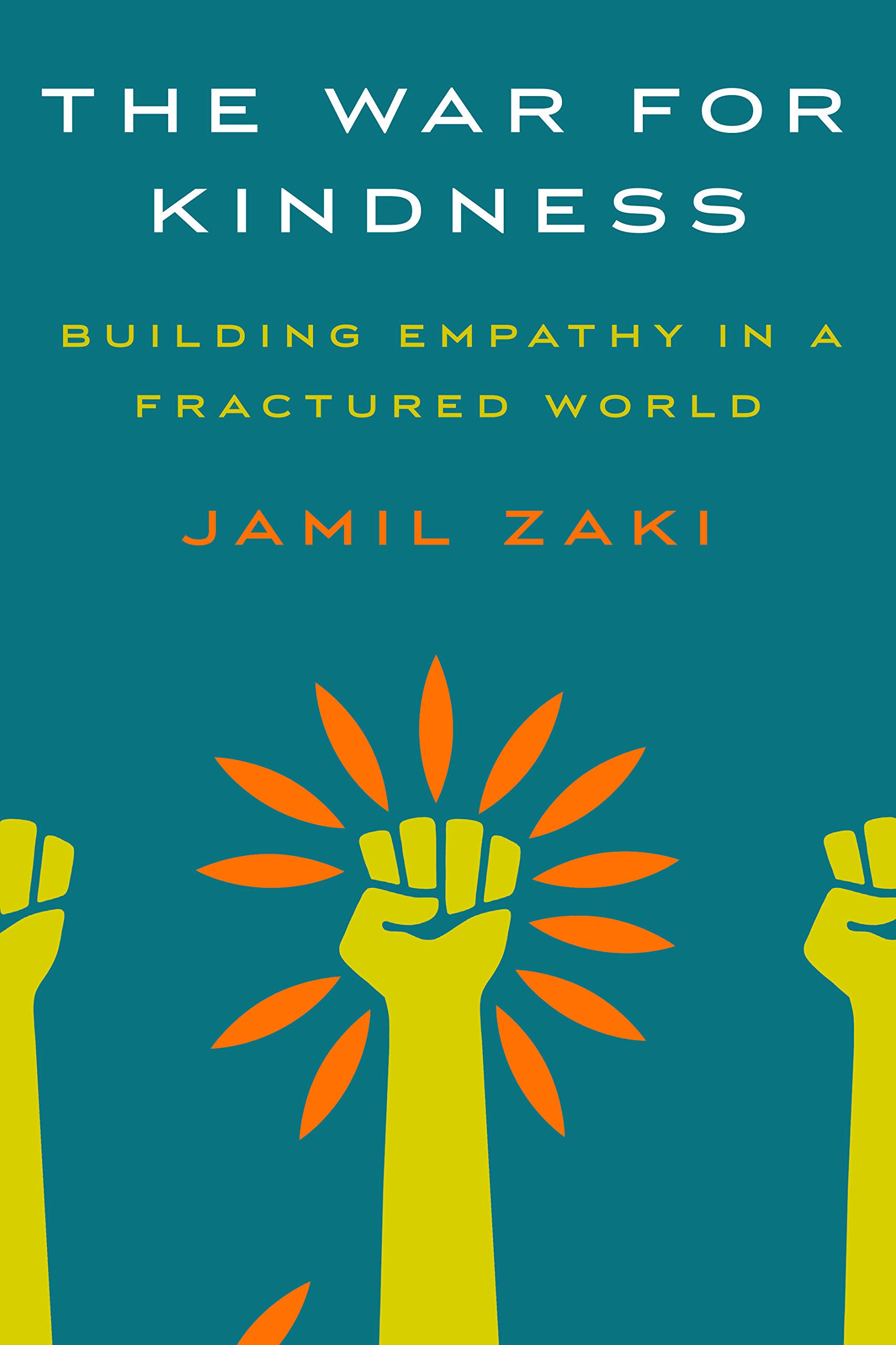
The War for Kindness by Jamil Zaki
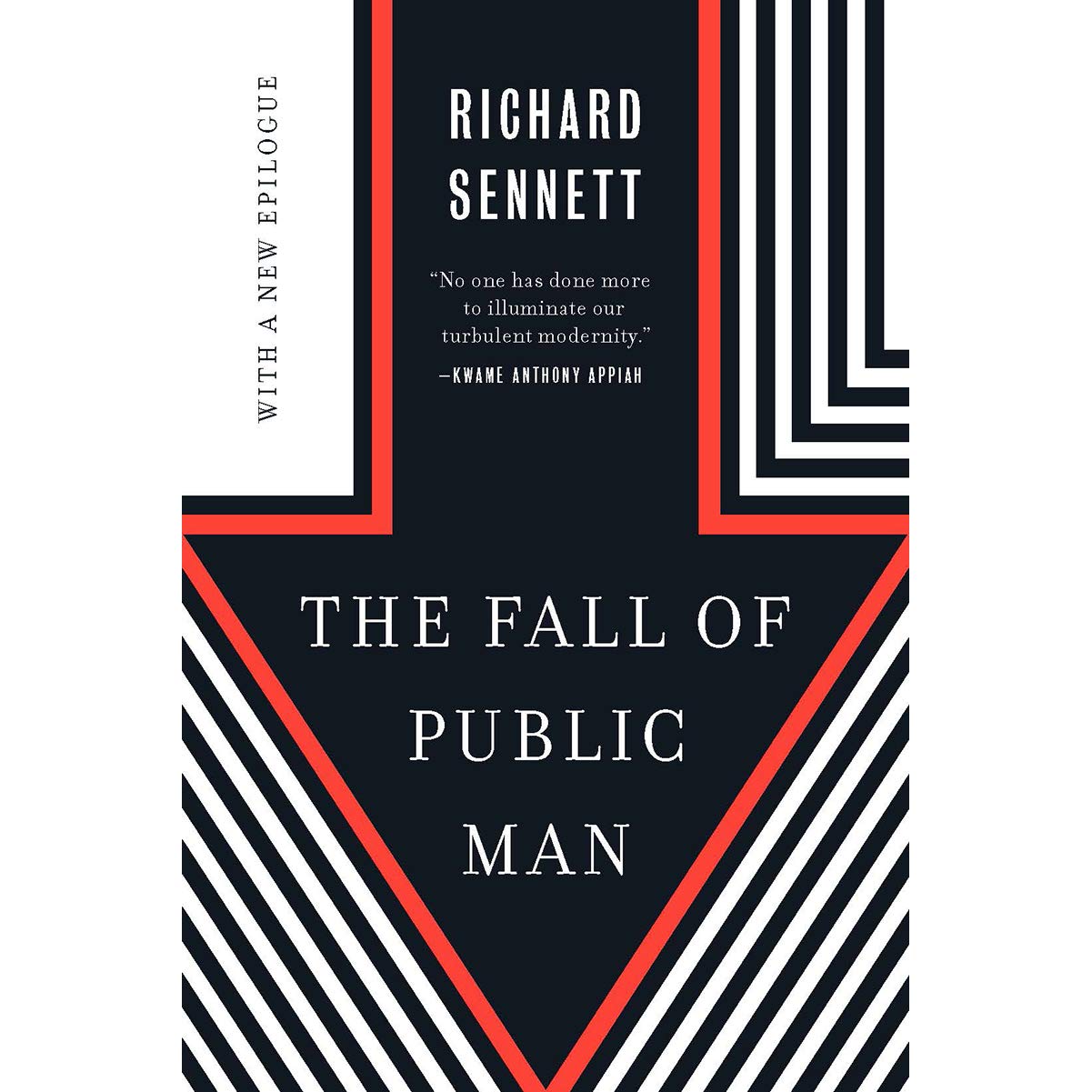
The Fall of Public Man by Richard Sennett
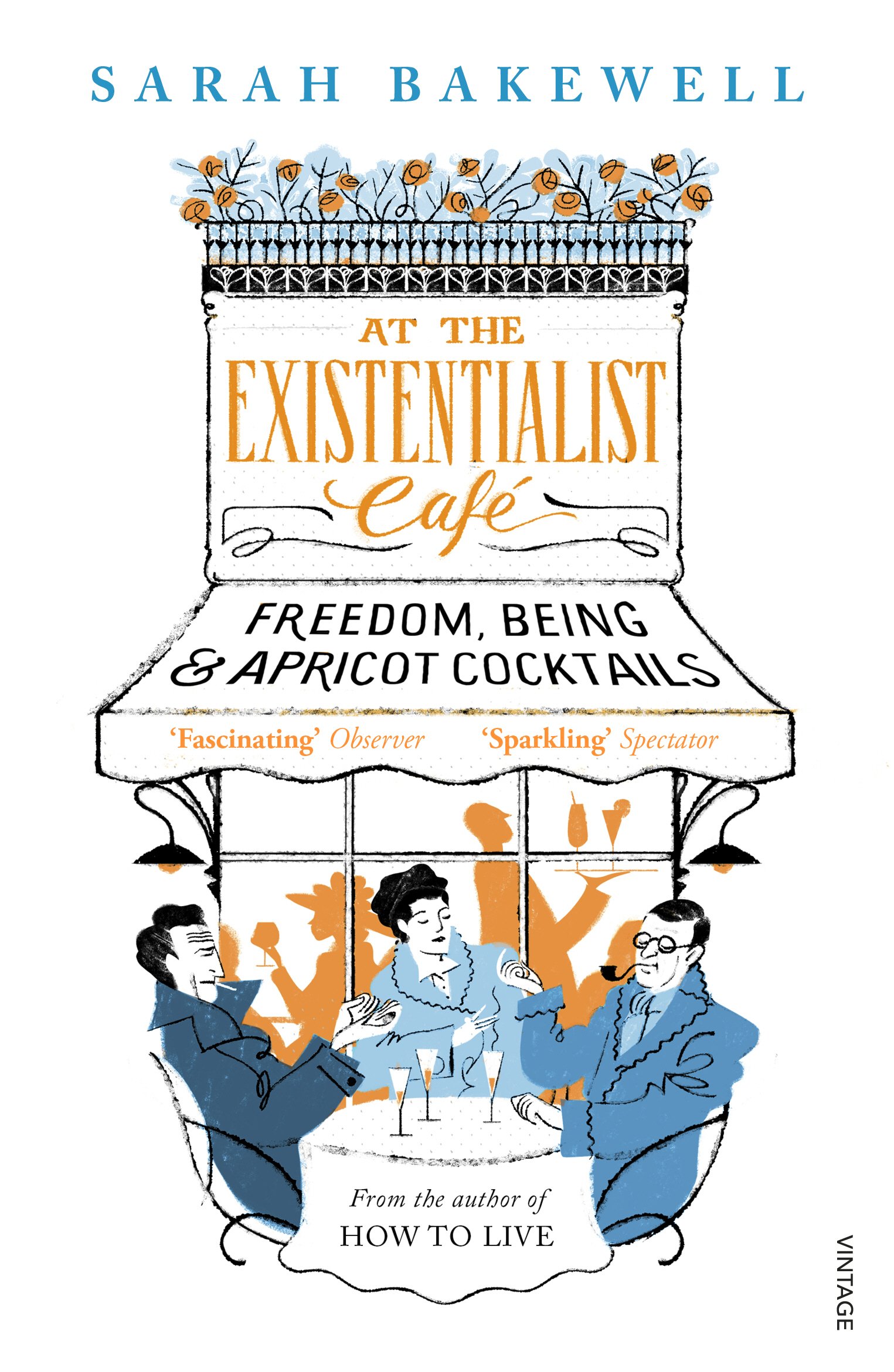
At the Existentialist Café by Sarah Bakewell
Invisible Cities by Italo Calvino
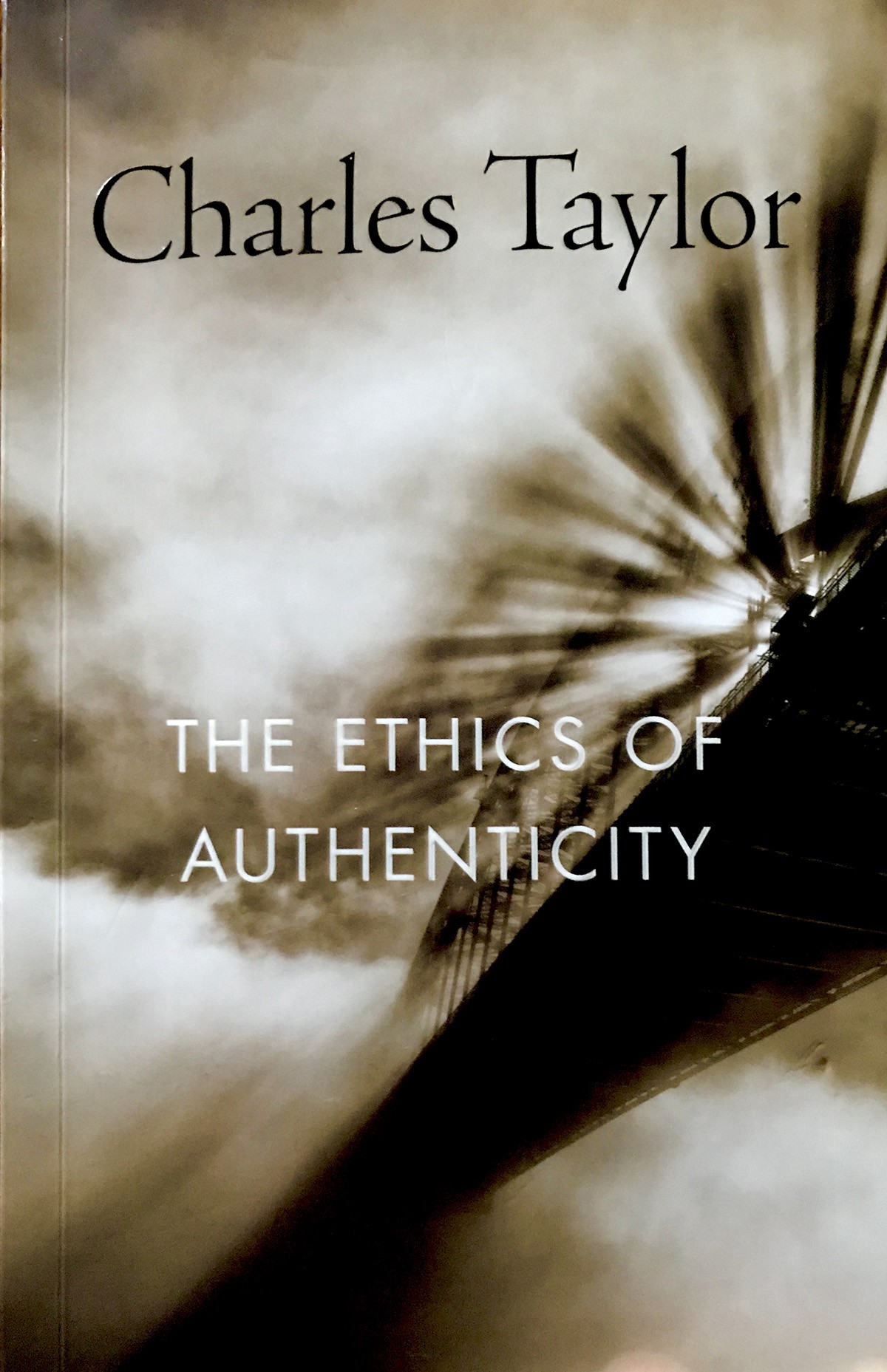
The Ethics of Authenticity by Charles Taylor
Looking for Spinoza by Antonio Damasio
Identity: The Demand for Dignity and the Politics of Resentment by Francis Fukuyama
How Behavior Spreads by Damon Centola
Reductionism in Art and Brain Science by Eric Kandel
Notre-Dame de Paris Fire

On April 15, 2019, Notre Dame Cathedral of Paris caught fire. It did not take long for the spire to collapse, together with the wooden beams dating back to the 13th century. Arguably, the French was among those who suffered most from this tragedy, as the symbol of their culture was destroyed, or to put it more cruelly as one Parisian does, “Paris is beheaded.” As the news of the fire spread across China’s social media, however, it surprises me a bit as to what extent my Chinese friends have empathized with the French in suffering from their loss—many posted photos taken months or years ago during their trip to Paris, with the Cathedral in the background, paired with captions expressing their sadness and sorrow. In the meantime, however, a different voice emerges, linking the fire to the destruction of the Old Summer Palace of China by the Anglo-French force in 1860, during the Second Opium War. As a Wechat user commented below one of the reports on the Notre Dame fire, “While I acknowledge the value of the cathedral and feel sorry for its destruction, I find it somewhat satisfying taking it to be the result of heavenly justice (天道轮回).” 

In this image made available on Tuesday April 16, 2019 flames and smoke rise from the blaze as the spire starts to topple on Notre Dame cathedral in Paris, Monday, April 15, 2019. An inferno that raged through Notre Dame Cathedral for more than 12 hours destroyed its spire and its roof but spared its twin medieval bell towers, and a frantic rescue effort saved the monument’s “most precious treasures,” including the Crown of Thorns purportedly worn by Jesus, officials said Tuesday. (AP Photo/Thierry Mallet)
Old Summer Palace, Beijing. (颐园新居 [CC BY-SA (https://creativecommons.org/licenses/by-sa/3.0)%5D)

Both voices ended up receiving harsh criticism on the Chinese social media platforms, such as Wechat and Zhihu. On the one hand, many consider those expressing their sadness for the Notre Dame fire in their Wechat Moments to be “unduly sentimental”, given most of them had little personal connection with the Cathedral which would make sadness the appropriate reaction to its destruction. After all, many of those expressing their sadness had neither been to Paris nor read Victor Hugo’s The Hunchback of Notre-Dame; even fewer had studied architecture or art history, which would help them fully appreciate the artistic and historical value of the Cathedral. On the other hand, those alluding to the Old Summer Palace narrative were accused of being “parochial nationalists”, who fail to recognize the universal value of cultural heritage which transcends the history of conflict between nations.

Here I want to suspend from adjudicating between these views and, rather, hope to uncover the motivations driving these views as well as people’s reactions to them, by drawing evidence from works in the philosophy of emotion, as well as the psychology of empathy and social identity.

What strikes me in the first kind of voices is the extent to which people make evaluations about the appropriateness of emotions. In saying that others’ reaction reactions to the destruction of the Cathedral is unduly sentimental, one is essentially positing a standard of appropriateness for the experience as well as expression of emotions. And this standard seems largely derived from their expectations of the extent to which people value the intentional object of their emotion—in the case, the Cathedral. This explains why these criticizers, while denouncing most of their fellow Chinese citizens’ reactions as insincere, acknowledge the appropriateness of the experience of sadness by the French people, as well as Chinese citizens who are “sufficiently informed” in architecture and art history—after all, their sadness is a true manifestation of their valuation of the Cathedral, given the central role the Cathedral has been playing in their lives. In other words, the sadness expressed for the Notre-Dame fire is interpreted by many to be insincere, insofar as most of the Chinese mourners do not really value the Cathedral but manages to appear so on social media, potentially because this enables them to construct a self-image of a compassionate person who is capable of appreciating the value of Western art.

While perceived insincerity doubtlessly drives the first type of criticism, I do not believe it is the whole story. Another factor driving the criticism is the belief that the experienced sadness, though it can be sincere, is essentially hypocritical—in valuing Notre-Dame Cathedral, such people fail to acknowledge things that are equally or more valuable and fail to react to them appropriately. To better understand this psychology, it would be helpful to look at an additional (and subtler) voice among the criticizers of the Chinese mourners. Here is a comment on Zhuhu: “Why aren’t people sorry for the French bombing of Damascus? Or is it that only treasures of developed countries are valuable?” (“为什么法国轰炸大马士革的时候没有人感到惋惜?…难道就发达国家的是瑰宝?”) Apparently, the commenter does not necessarily deny the value of Notre Dame Cathedral and acknowledges that those among their fellow citizens who express sadness may indeed be sincere, insofar as they judge the Cathedral to be an important part of their life. What they have trouble with, however, is the fact that those who mourn for the destruction of Notre Dame Cathedral fail to mourn for the destruction of things that are comparably valuable, such as the historical sites in Damascus. And this failure to experience sadness implies an inappropriate value judgment by the agent—namely, the historical sites in Damascus is not as important as Notre Dame of Paris, underlying which is the more worrying judgment that cultural heritages of the Middle East are not as valuable as those of Europe. This concern speaks to Paul Bloom’s argument against empathy as the guide for our moral judgment. After all, if empathy as an emotion is itself based on certain judgments, using empathy as our moral compass would only reinforce those preexisting value judgments, which may be biased to begin with.

Therefore, the denouncement of sadness for the destruction of Notre Dame but not for other historical sites can be interpreted as the rejection of a Eurocentric narrative, which exclusively focuses on European culture and history and regard them as somewhat superior to other cultures. Such tendencies are vehemently at odds with the Chinese nationalist narrative, which places the Chinese at an intrinsically higher position on the value hierarchy. Thus, the apparently exclusive valuation Notre Dame is a warning sign for these people, as if it comes inevitably at the expense of valuing what is congruent with their national identity—namely, Chinese culture and art. Crucially, this interpretation helps us understand the motivations of the “explicit nationalists”, who take the burning of Notre Dame Cathedral as a manifestation of heavenly justice, and what the French deserves for the atrocities they committed over 150 years ago. This view, of course, is indefensible. It draws a false analogy between the burning of the Old Summer Palace—an act of imperial violence, and the burning of Notre Dame—reportedly an accident. Indeed, the Anglo-French invaders committed an unspeakable crime and deserve punishment. The subject of this moral desert, however, is whatever that has a direct connection to their crimes—the Anglo-French soldier who participated in the war, the imperialist zeitgeist driving them, etc. None of these, as far as I can see, is connected to Notre Dame Cathedral in any plausible way, expect for the fact they are all French. The nationalist response, then, can be seen as the result of a psychological mechanism that at times give rise to irrational thoughts and behaviors: social identification. Identification with the Chinese nationalist narrative (with a particularly strong focus on the “semi-colonial-semi-feudal experiences” during the late Qing dynasties here drives not only the emotional responses to the event (i.e. satisfaction toward perceived heavenly justice), but also the belief that these responses are justified. As someone comments under the aforementioned Wechat article: “As Chinese, as I realize the magnificence of the Old Summer Palace can only be retrieved from photo archive, [while in reality] all I can see is debris and dilapidation, wouldn’t it be appropriate to think: ‘the heaven is indeed just’?” (“作为中国人,当圆明园的富丽堂皇只能在老旧照片里见证,目之所及一片断壁残垣的时候,心里念一句天道好轮回,并不为过吧?”)

It is not to say, of course, that it would be wrong to think of the Old Summer Palace as one hears the news concerning the destruction of Notre Dame Cathedral. Despite their differences, the group-based emotional experiences of the Chinese and the French share commonalities, insofar as both involve the destruction (whether intentional or accidental) of what each party takes to be valuable as well as central to their identity. Therefore, one would expect simulations of the pain over the destruction of the Old Summer Palace to help Chinese people better empathize with the French. 

Why write this blog?

It’s my first time publishing a personal blog–or at least the first time I intend to use one substantially to record my thoughts and feelings. I used to hold the somewhat solipsistic belief that ideas and feelings are not really worth spreading; instead, the only thing that matters is they appear real at the moment I experience them. But I gradually came to realize that beliefs, ideas, even feelings, can take a concrete shape only after being deliberated and written down, ready for examination by an audience who may or may not share the contexts in which I initially conceive them. This blog therefore is not only a search for intersubjectivity–for shared memories and emotions, but also an opportunity for me to hold a more critical attitude toward my own thoughts and feelings, and to render them clearer through expression.