On April 15, 2019, Notre Dame Cathedral of Paris caught fire. It did not take long for the spire to collapse, together with the wooden beams dating back to the 13th century. Arguably, the French was among those who suffered most from this tragedy, as the symbol of their culture was destroyed, or to put it more cruelly as one Parisian does, “Paris is beheaded.” As the news of the fire spread across China’s social media, however, it surprises me a bit as to what extent my Chinese friends have empathized with the French in suffering from their loss—many posted photos taken months or years ago during their trip to Paris, with the Cathedral in the background, paired with captions expressing their sadness and sorrow. In the meantime, however, a different voice emerges, linking the fire to the destruction of the Old Summer Palace of China by the Anglo-French force in 1860, during the Second Opium War. As a Wechat user commented below one of the reports on the Notre Dame fire, “While I acknowledge the value of the cathedral and feel sorry for its destruction, I find it somewhat satisfying taking it to be the result of heavenly justice (天道轮回).”
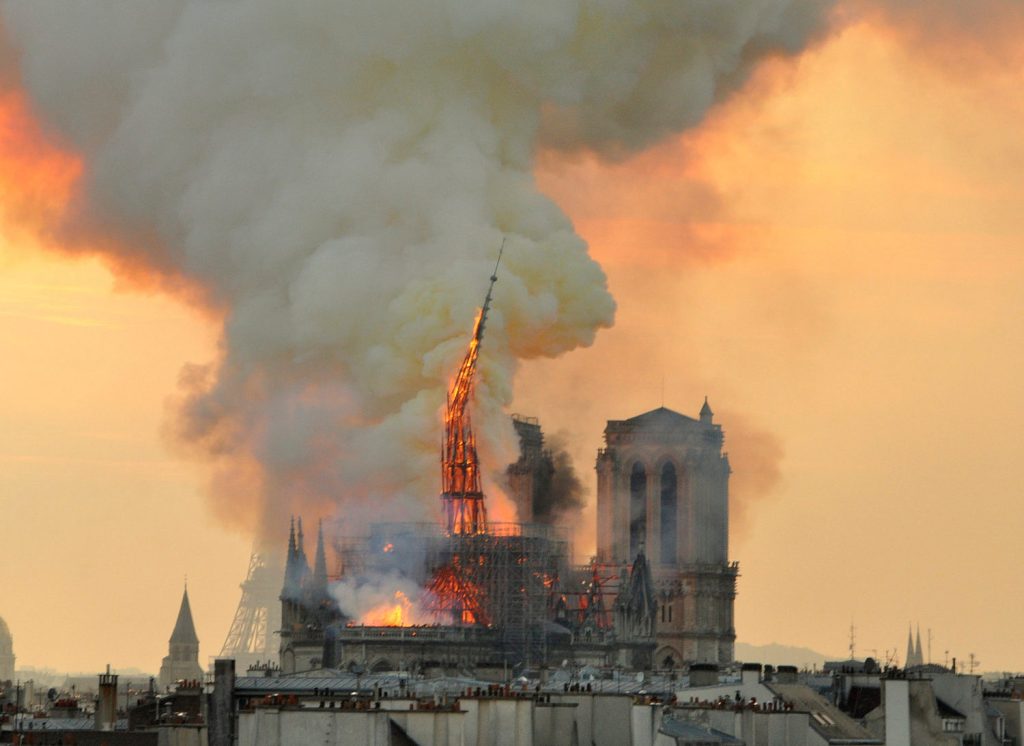

Both voices ended up receiving harsh criticism on the Chinese social media platforms, such as Wechat and Zhihu. On the one hand, many consider those expressing their sadness for the Notre Dame fire in their Wechat Moments to be “unduly sentimental”, given most of them had little personal connection with the Cathedral which would make sadness the appropriate reaction to its destruction. After all, many of those expressing their sadness had neither been to Paris nor read Victor Hugo’s The Hunchback of Notre-Dame; even fewer had studied architecture or art history, which would help them fully appreciate the artistic and historical value of the Cathedral. On the other hand, those alluding to the Old Summer Palace narrative were accused of being “parochial nationalists”, who fail to recognize the universal value of cultural heritage which transcends the history of conflict between nations.
Here I want to suspend from adjudicating between these views and, rather, hope to uncover the motivations driving these views as well as people’s reactions to them, by drawing evidence from works in the philosophy of emotion, as well as the psychology of empathy and social identity.
What strikes me in the first kind of voices is the extent to which people make evaluations about the appropriateness of emotions. In saying that others’ reaction reactions to the destruction of the Cathedral is unduly sentimental, one is essentially positing a standard of appropriateness for the experience as well as expression of emotions. And this standard seems largely derived from their expectations of the extent to which people value the intentional object of their emotion—in the case, the Cathedral. This explains why these criticizers, while denouncing most of their fellow Chinese citizens’ reactions as insincere, acknowledge the appropriateness of the experience of sadness by the French people, as well as Chinese citizens who are “sufficiently informed” in architecture and art history—after all, their sadness is a true manifestation of their valuation of the Cathedral, given the central role the Cathedral has been playing in their lives. In other words, the sadness expressed for the Notre-Dame fire is interpreted by many to be insincere, insofar as most of the Chinese mourners do not really value the Cathedral but manages to appear so on social media, potentially because this enables them to construct a self-image of a compassionate person who is capable of appreciating the value of Western art.
While perceived insincerity doubtlessly drives the first type of criticism, I do not believe it is the whole story. Another factor driving the criticism is the belief that the experienced sadness, though it can be sincere, is essentially hypocritical—in valuing Notre-Dame Cathedral, such people fail to acknowledge things that are equally or more valuable and fail to react to them appropriately. To better understand this psychology, it would be helpful to look at an additional (and subtler) voice among the criticizers of the Chinese mourners. Here is a comment on Zhuhu: “Why aren’t people sorry for the French bombing of Damascus? Or is it that only treasures of developed countries are valuable?” (“为什么法国轰炸大马士革的时候没有人感到惋惜?…难道就发达国家的是瑰宝?”) Apparently, the commenter does not necessarily deny the value of Notre Dame Cathedral and acknowledges that those among their fellow citizens who express sadness may indeed be sincere, insofar as they judge the Cathedral to be an important part of their life. What they have trouble with, however, is the fact that those who mourn for the destruction of Notre Dame Cathedral fail to mourn for the destruction of things that are comparably valuable, such as the historical sites in Damascus. And this failure to experience sadness implies an inappropriate value judgment by the agent—namely, the historical sites in Damascus is not as important as Notre Dame of Paris, underlying which is the more worrying judgment that cultural heritages of the Middle East are not as valuable as those of Europe. This concern speaks to Paul Bloom’s argument against empathy as the guide for our moral judgment. After all, if empathy as an emotion is itself based on certain judgments, using empathy as our moral compass would only reinforce those preexisting value judgments, which may be biased to begin with.
Therefore, the denouncement of sadness for the destruction of Notre Dame but not for other historical sites can be interpreted as the rejection of a Eurocentric narrative, which exclusively focuses on European culture and history and regard them as somewhat superior to other cultures. Such tendencies are vehemently at odds with the Chinese nationalist narrative, which places the Chinese at an intrinsically higher position on the value hierarchy. Thus, the apparently exclusive valuation Notre Dame is a warning sign for these people, as if it comes inevitably at the expense of valuing what is congruent with their national identity—namely, Chinese culture and art. Crucially, this interpretation helps us understand the motivations of the “explicit nationalists”, who take the burning of Notre Dame Cathedral as a manifestation of heavenly justice, and what the French deserves for the atrocities they committed over 150 years ago. This view, of course, is indefensible. It draws a false analogy between the burning of the Old Summer Palace—an act of imperial violence, and the burning of Notre Dame—reportedly an accident. Indeed, the Anglo-French invaders committed an unspeakable crime and deserve punishment. The subject of this moral desert, however, is whatever that has a direct connection to their crimes—the Anglo-French soldier who participated in the war, the imperialist zeitgeist driving them, etc. None of these, as far as I can see, is connected to Notre Dame Cathedral in any plausible way, expect for the fact they are all French. The nationalist response, then, can be seen as the result of a psychological mechanism that at times give rise to irrational thoughts and behaviors: social identification. Identification with the Chinese nationalist narrative (with a particularly strong focus on the “semi-colonial-semi-feudal experiences” during the late Qing dynasties here drives not only the emotional responses to the event (i.e. satisfaction toward perceived heavenly justice), but also the belief that these responses are justified. As someone comments under the aforementioned Wechat article: “As Chinese, as I realize the magnificence of the Old Summer Palace can only be retrieved from photo archive, [while in reality] all I can see is debris and dilapidation, wouldn’t it be appropriate to think: ‘the heaven is indeed just’?” (“作为中国人,当圆明园的富丽堂皇只能在老旧照片里见证,目之所及一片断壁残垣的时候,心里念一句天道好轮回,并不为过吧?”)
It is not to say, of course, that it would be wrong to think of the Old Summer Palace as one hears the news concerning the destruction of Notre Dame Cathedral. Despite their differences, the group-based emotional experiences of the Chinese and the French share commonalities, insofar as both involve the destruction (whether intentional or accidental) of what each party takes to be valuable as well as central to their identity. Therefore, one would expect simulations of the pain over the destruction of the Old Summer Palace to help Chinese people better empathize with the French.
 Yi's Blog